Get paid to
buy the dip.
Get paid to wait for your price.
Name a price you’d be glad to buy a good company at, and collect a premium for waiting there. levelbox.ai shows the premium, the chance of assignment, and the downside on every candidate — before you sell.
Free forever · No card required
levelbox.ai is the analysis, not your broker. You place the trades.
Trend, breadth, credit and volatility, read daily. Sign up for the full breakdown →
Each row is ticker · discount · premium · DTE — how far below today's price you'd agree to buy, and the credit for that term, in dollars and as a percentage of the collateral tied up. Strike and the exact expiry date are behind the login. Sign up to see the full ticket →
Live screen output — educational, not investment advice.
- investing themes
- 8
- names in the universe
- 200+
- superinvestors tracked via 13F
- 17
- SEC Form 4 insider ingest
- Daily
- deep dives on the method
- 20+
What is levelbox.ai?
levelbox.ai is analytical, educational software for running the options wheel — getting paid to wait to buy good companies at your price. It screens themes(?) — see theme deep-dives of names worth owning, scores each with a Wheel Score, and ranks the best cash-secured-put candidates with the premium and the risk shown side by side.
It adds two things a screener normally leaves out. It shows who else has been buying — insider net flow from SEC Form 4 filings, and 13F position changes across 17 tracked superinvestors. And it works across a whole book, not one ticket: it stress tests every position together against a market drawdown, and plans a path to selling more premium inside a crash-drawdown budget and an expected-assignment budget you set.
See the whole trade before you make it.
Start with a theme you believe in.
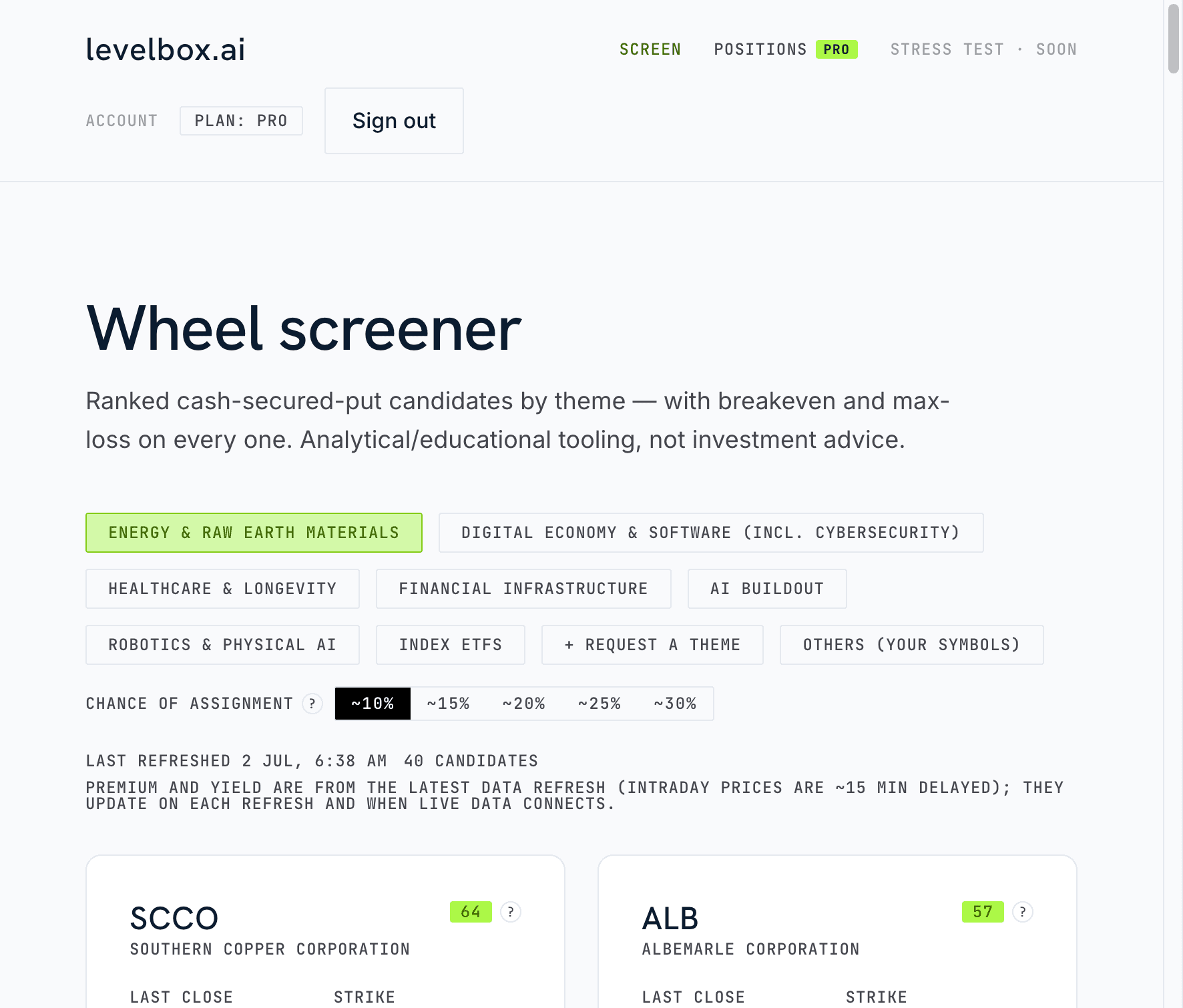
Pick a theme — the AI buildout, robotics, defence tech, healthcare — and levelbox.ai ranks the cash-secured-put candidates worth owning, scored on quality, premium, liquidity and price.
See who else has been buying.
A cheap price tells you nothing about whether the people closest to the business agree. levelbox.ai pulls insider trades straight from SEC Form 4 filings and position changes from 13F filings, then puts both on the card: net insider flow over 90 days, and which tracked superinvestors bought, sold, or are still holding. How the signal is built.
Insider figures are the 90-day net discretionary open-market flow from SEC Form 4 filings — options exercises and scheduled sales stripped out, because those say nothing about conviction. The 13F lines are last quarter’s position changes across 17 tracked filers. Public record, presented symmetrically: you see the selling as plainly as the buying.
Warren Buffett · Bill Ackman · Michael Burry · Carl Icahn · David Tepper · Stanley Druckenmiller · Seth Klarman · Daniel Loeb · Nelson Peltz · Chase Coleman · Philippe Laffont · Chris Hohn · ValueAct · Mohnish Pabrai · Li Lu · Chuck Akre · Terry Smith
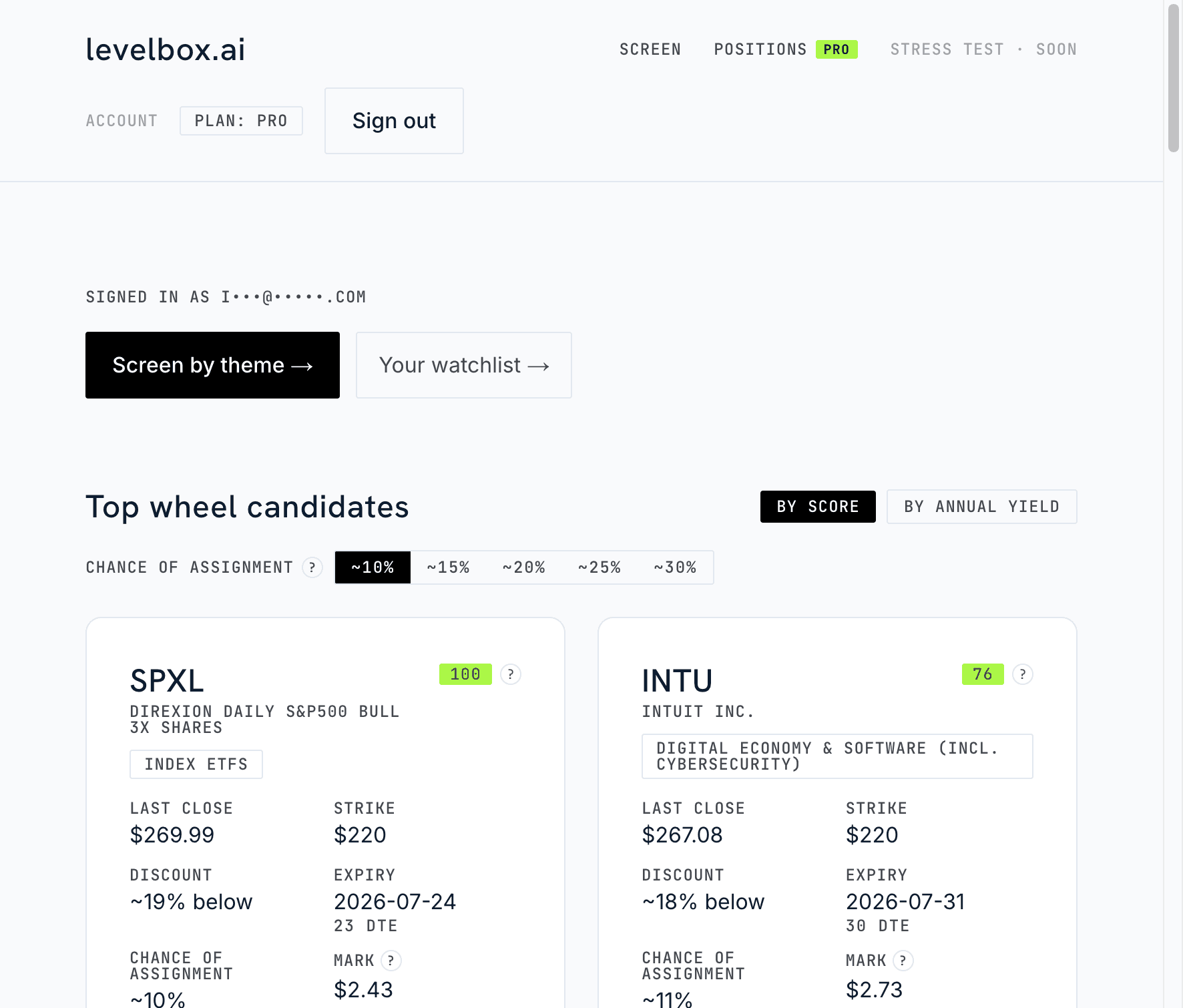
See the downside before you commit.
Every candidate carries its breakeven, its maximum loss, the discount to today’s price, and the chance of assignment — computed from the option maths as N(−d₂), skew-corrected, rather than the delta shortcut most tools use. It also flags softening fundamentals, a falling knife, decaying leveraged instruments, and earnings that land inside your expiry. Why delta isn’t that number.
Know exactly what it ties up.
Track the names you’d wheel and see the projected premium, the capital each put secures, and how long it stays committed — so you deploy capital on purpose.
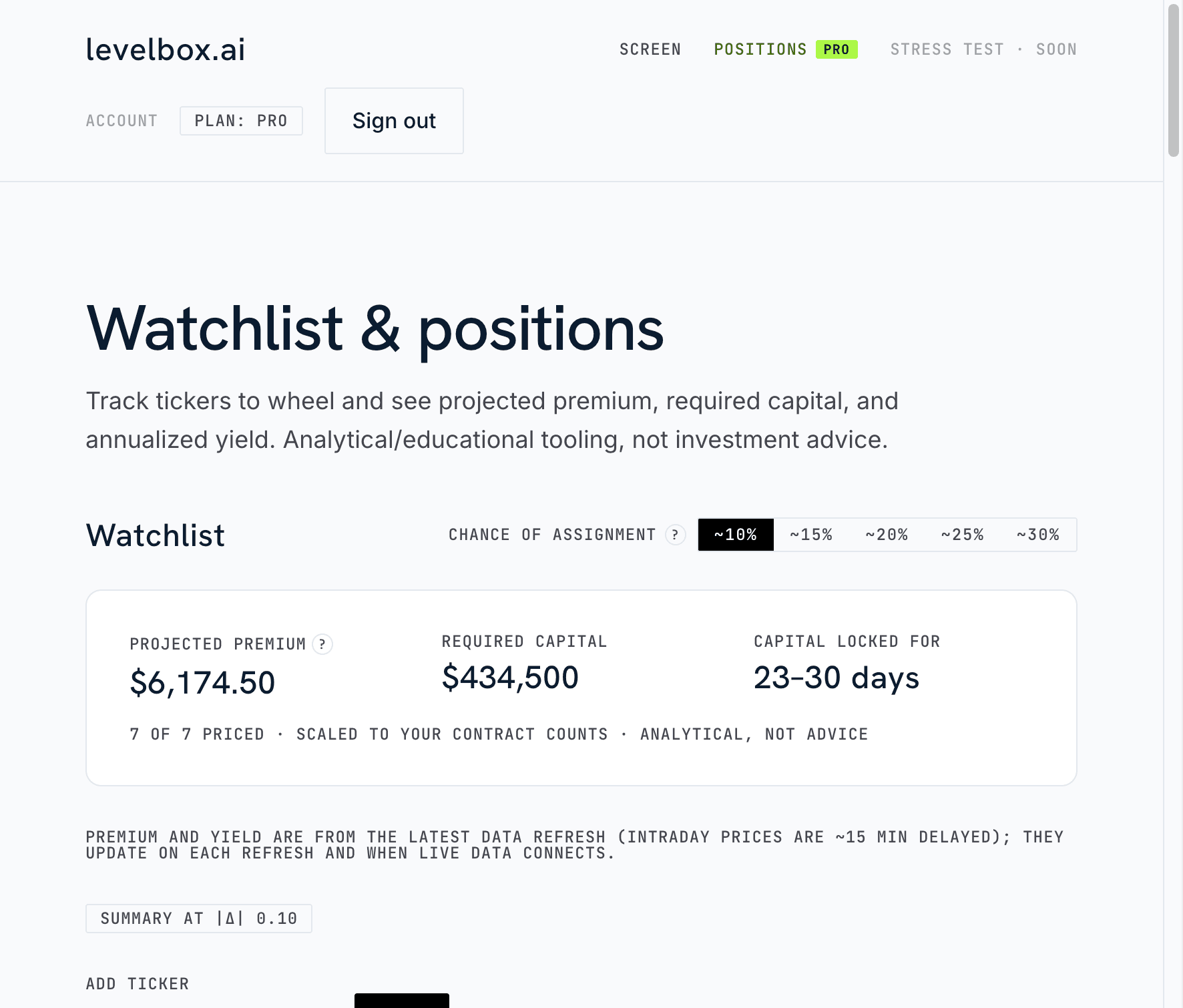
Screens shown with example data — not recommendations.
Stop reading. Start screening.
Screen cash-secured puts by theme. The premium, the capital each ties up, the chance of assignment, and who else has been buying — on every candidate. Free, no card required.
One good trade at a time still adds up to one bad week.
Picking sound candidates is the easy half. The half that decides the outcome is how much of your capital sits behind them at once, and what happens to all of it in the same bad month. levelbox.ai models the book, not the ticket — a portfolio risk simulator for the drawdown, and a portfolio optimiser for what you can safely sell against it.
Would your book survive the drawdown?
Short puts look uncorrelated one at a time. Across a book they are the same trade wearing different tickers. The portfolio risk simulator shocks every position together and reports the loss as a share of your net asset value.
- Each name, by its own beta — scaled from its 30-day implied vol against the market's, and clamped — high vol means volatile, not automatically correlated.
- Volatility, upward — implied vol expands as the drawdown deepens, on top of a downside skew bump, because that is when short puts hurt twice.
- Margin, recomputed — requirements are re-derived at the shocked prices, so the panel reflects the call you would actually get.
Over budget is not a verdict — it’s the input to the plan on the right.
Two budgets in. A phased plan out.
The portfolio optimiser turns a crash-drawdown budget and an expected-assignment budget into a plan for selling more premium.
- 01
De-risk what's over budget
The engine finds the positions carrying the drawdown, and trims only until the book fits the budget you set — not to a number it picked.
- 02
Redeploy the freed capital
Cash goes back out into cash-secured puts at a delta band you choose, on names that clear the screen.
- 03
Add premium within both budgets
More premium, but only while crash drawdown and expected assignment both stay inside their ceilings. When a budget binds, the plan stops.
Expected assignment is measured in dollars, not delta — the sum of strike × contracts × N(−d₂) across the book, so it caps how much stock you could actually be handed, not just how risky each leg looks.
The screener is free. The portfolio tools roll out to early accounts as they land — why a book of short puts is one position.
Selling puts, the way a fundamental investor would.
A cash-secured put is not a trading gimmick. It is a way to be paid for agreeing to buy a good business at a price you set. On the right company, it is patience with a coupon.

In 1993, Berkshire sold put options on Coca-Cola struck near $35 and kept the premium upfront: if Coke fell there, Buffett owned more of a company he already wanted at a level he liked, and if it didn't, he kept the cash. If a private bank has ever pitched you a fixed coupon note, you have seen the same trade with a spread stapled on.
How levelbox.ai reads a company
Before any option is considered, a name is scored on three lenses. The checks are mechanical; the judgement stays yours.
“It's far better to buy a wonderful company at a fair price than a fair company at a wonderful price.”
— Warren Buffett
The check: durable returns (ROE ~15%+), real pricing power, low debt, earnings that hold up. A company you'd hold through a bad year.
“Know what you own, and know why you own it.”
— Peter Lynch
The check: a PEG below 1, earnings growth in the real 15–30% band rather than frothy, and inventories that aren't running ahead of sales.
That's why levelbox.ai is organised into themes(?) — see theme deep-dives — screen where you already have an edge.
“Simple, predictable, free-cash-flow-generative, dominant.”
— Bill Ackman, on the businesses Pershing Square buys
The check: strong free cash flow, high returns on invested capital, recurring revenue, and interest cover that leaves no doubt about the balance sheet.
The Wheel Score blends these with the option's premium, its liquidity, and where price sits against support — and flags when a name's trajectory is softening, because a cheap price is not a margin of safety. It tells you a name is worth a closer look; what you do with that is your call.
Scored by their criteria. Checked against their filings.
Buffett, Lynch and Ackman are how levelbox.ai grades a business. Two of them — and 15 others, from Burry and Icahn to Klarman, Li Lu and Terry Smith — also file 13Fs every quarter, which is public record. So the same card that scores a name on their criteria also shows whether they were buying it, selling it, or sitting on it last quarter, alongside what the company’s own insiders did with their money.
It is context, not a signal to copy. Filings are up to 45 days stale by the time they are public, and a great investor’s position was sized for their book, not yours.
I run the wheel on my own account. Two habits kept costing me: taking rich premium on names I didn't really want, and sizing by feel. So I built the checks I wish I'd had — quality first, the capital each trade ties up shown plainly, the downside on screen before the trade, and a stress test on the whole book rather than one leg at a time. It made me steadier, and slower in the right way. If that's the part you find hard, you'll understand this quickly.
— Founder, building levelbox.ai in the open
Run the screen from inside your own assistant.
levelbox.ai speaks MCP. Ask your assistant for 30-day puts near 0.10 delta on names you'd own, and get back a ranked list with strikes, premium, yield and risk. Pro accounts get optimize_income too — the same planner the web app runs, byte for byte.
Every candidate returns annualised yield, breakeven, and max loss.
Common questions.
What does levelbox.ai do, and what makes it different?
It ranks cash-secured-put candidates within a theme and shows the numbers that matter on each — premium, annualised yield, breakeven, and max loss — with the underlying graded through the Buffett, Lynch, and Ackman lenses. The Wheel Score blends fundamentals, premium, liquidity, and price into one ranking, so risk always sits next to reward.
Does it show who else has been buying?
Yes. Every name carries its 90-day net discretionary insider flow from SEC Form 4 filings, plus which of 17 tracked superinvestors — Buffett, Ackman, Burry, Icahn, Tepper, Druckenmiller, Klarman, Li Lu and others — recently bought it, recently sold it, or are still holding. Public-record context, shown symmetrically; 13F data can be up to 45 days old when it becomes public.
How is the chance of assignment calculated?
As N(−d2), the risk-neutral probability of finishing in the money, with a volatility-skew correction and a put-call-parity forward. Most tools substitute the option's delta, which overstates it on puts. levelbox.ai reports the corrected figure and marks the candidate when the correction could not be applied.
Can it analyse my whole portfolio?
That is what Pro is for: a risk simulator that shocks every position together against a market drawdown and reports the loss as a share of your net asset value, and a portfolio optimiser that plans a phased path to more premium inside a crash-drawdown budget and an expected-assignment budget you set. Portfolios import from Interactive Brokers.
Is levelbox.ai free?
Yes — the screener is free to start, no card required: the Wheel Score, per-candidate premium, yield, breakeven and max loss, the insider and 13F social-proof signals, and top picks across themes. A Pro tier for running real capital across a portfolio is in development.
Does levelbox.ai place trades or hold my money?
No. levelbox.ai is the analysis, not your broker — it never executes trades or holds funds; you place any trades yourself. It's educational tooling, not investment advice.
Can I connect it to an AI assistant like Claude?
Yes — levelbox.ai exposes its screener over MCP, so Claude or your own agent can pull ranked candidates in plain language. There's also a free, open-source set of Claude skills, option-wheeling-skills, for running the wheel with an assistant.
Start free. Pro when it’s ready.
Starter
Enough to screen properly.
Wheel screener across every theme, ranked by the Wheel Score.
Premium, annualised yield on capital, breakeven, and maximum loss on every candidate.
Insider net-flow and 13F superinvestor activity on the names you screen.
Chance of assignment from the option maths, not a delta stand-in.
Health flags: IV trend, softening fundamentals, earnings inside your expiry.
The daily market-regime read, and a daily wheel digest by email.
MCP access, fair use.
Pro
For running real capital across positions.
Stress test: what a US drawdown does to your whole book, not one leg.
Portfolio optimiser: a phased path to selling more premium inside a crash-drawdown budget and an expected-assignment budget you set.
Portfolio import from IBKR, with your real yield and exposure.
Weekly coaching review of where your book stands and the week ahead.
Wheel any symbol, beyond our themes. (in development)
Higher MCP limits, including optimize_income.
Price still being set. Early free accounts get the Pro tools in beta as they land, and first access when Pro launches.
See the whole trade first.
Screen cash-secured puts by theme, with the premium, the capital each ties up, the chance of assignment, and who else has been buying — on every candidate.
Free to start · No card required · Unsubscribe anytime