Defense Tech, Four Scenarios: Fat Premium, No Floor (as of 2026-07-13)
13 July 2026 · 8 min read
As of 2026-07-13. Educational and analytical only. Not investment advice. Numbers below come from a reproducible fact pack (yfinance, 2026-07-13, ET); the scenarios are point-in-time judgment on top of that data. Nothing here is a buy or sell instruction. Where a cash-secured put is mentioned, its max loss and breakeven are stated.
This article was generated by AI — levelbox's deep-dive tooling — and lightly reviewed. The data is point-in-time and can be wrong; if you spot a mistake, please tell us.
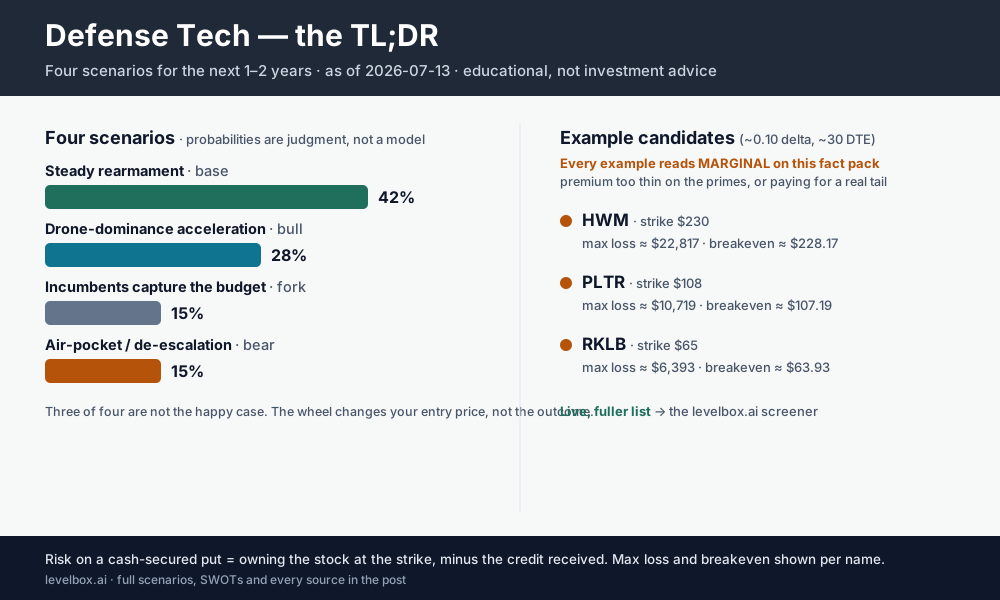
Defense is one of the loudest themes in the market right now. Record budgets, a rearmament cycle, drones everywhere. The narrative writes itself, which is usually the moment to slow down and look at the maths.
For a wheel seller the sector splits cleanly into two failure modes, and the screen surfaces both. The mega-cap primes — Lockheed, RTX, Northrop — are safe and boring, and the options market prices them that way. IV30 sits around 0.31, so the cash-secured put is well-collateralised and barely paid. The new-defense pure-plays — AVAV, KTOS, RKLB, LUNR — pay fat premium and come with brutal drawdowns. AVAV trades about 42% below its 200-day average with realized vol near 1.08. KTOS is down about 39%. There is no fundamental floor under the strike, so the premium is compensation for a real tail.
The names that actually fit the wheel lens are the middle: the picks-and-shovels component suppliers — HWM, TDY, CW, HEI, MSI — quality businesses with tolerable premium. This is scenario planning rather than a tip sheet. The point is to know which failure mode you are walking into before the premium tempts you.
Four scenarios
Probabilities below express judgment rather than the output of a forecast model. They are one reading of the budget cycle and the geopolitics as of 2026-07-13.
Steady rearmament · 42%
The base case. The enacted FY2026 defense topline of about $838.7B, roughly $8.4B above the request, funds a broad multi-year procurement and munitions-replenishment cycle without an explosive step-change. About $6.5B goes to conventional and hypersonic munitions, roughly 2,000 long-range weapons. Primes and component suppliers grow into record backlogs; Howmet has already raised its FY26 revenue guide to $9.575-9.725B on record aero plus healthy defense. Nothing re-rates violently. Winners are HWM, TDY, CW and GD. Relative laggards are the richly valued names like PLTR and RKLB, which need more than a base case to justify the multiple.
What would break this read: a full-year Continuing Resolution that freezes new-starts and production-rate increases, or an enacted topline that stops procurement growing year on year.
Drone-dominance acceleration · 28%
The bull case, and it is a big one. The FY2027 request is the largest defense ask in US history — about $1.5T in total defense resources, roughly 48% over FY2026 — and it funds a step-change toward autonomous systems, space and software. Budget share rotates out of legacy heavy platforms into attritable drones and the software that commands them. The drone program alone runs about $54.6B, with roughly 200,000 platforms targeted by 2027 and $70B+ across drones and counter-drone. RKLB's backlog is $2.2B, up 108% year on year, including an $816M SDA Tranche-3 award; PLTR's US-government revenue is up 84% year on year. Winners broaden to PLTR, RKLB, AXON, AVAV and KTOS. The loser is heavy shipbuilding: HII loses share to attritable systems.
What would break this read: the FY2027 topline negotiated down toward the FY2026 CR level, or the drone money reallocated back into legacy programs.
Incumbents capture the budget · 15%
A fork in the bull case. The topline grows, but the money flows through programs of record and prime integrators rather than the pure-play startups. When the USMC selected the XQ-58 Valkyrie in January 2026, Northrop went in as prime integrator — a tell for how attritable-systems money actually gets spent. HWM, CW and TDY carry record backlogs and generate cash; the pre-profit pure-plays do not. Quality suppliers and primes win: HWM, CW, TDY, GD, MRCY. The unprofitable pure-plays stall despite a rising budget, so RKLB, AVAV, KTOS and LUNR lag.
What would break this read: a pure-play startup wins a nine-figure prime award directly rather than as a sub, or a new entrant displaces an incumbent on a program of record.
Budget air-pocket / de-escalation · 15%
The bear case, and it has two triggers. A full-year CR or a negotiated topline cut freezes new-starts and production-rate increases — under a CR the DOD is barred from new R&D starts and procurement rate increases (GAO), and OMB has held that appropriations should not exceed the roughly $897.6B CR level. Separately, a Ukraine ceasefire or broader de-escalation removes the geopolitical bid, and the sector's premium multiple partially reverses. Efficiency reviews squeeze the cost-plus IT-services names on top. What holds up is cash, patience, and the cheapest value cushions — LMT, HII and BAH all carry the screen's max value sub-score of 1.0. Hit hardest: the high-multiple, high-beta names (PLTR, RKLB, AXON, AVAV, KTOS), plus the efficiency-squeezed services names LDOS and CACI.
What would break this read: the topline enacted on time at or above the request while geopolitical tension persists. Then the premium multiple holds.
Three of the four scenarios above are not the happy one. That is worth holding in view before the wheel part. The probabilities exist to force the question the headlines skip: what does the premium actually pay you for if the base case does not land.
The wheel angle: worked examples
The wheel is simple. You sell a cash-secured put on a name you'd accept owning at the strike, and you get paid up front for the obligation. The risk is not exotic: it is owning the stock at the strike, minus the credit received. So the only names worth wheeling are ones you'd hold through a drawdown.
Run this theme's fact pack at about 0.10 delta and 30 DTE, and every worked example reads marginal. Treat these as illustrations of the maths rather than a shortlist:
| Ticker | Wheel read | CSP max loss | Breakeven | Strike / credit |
|---|---|---|---|---|
| HWM (Howmet) | marginal — top score, thin-ish premium | ≈ $22,817 | $228.17 | $230 / $1.83 |
| PLTR (Palantir) | marginal — quality + fat premium, valuation | ≈ $10,719 | $107.19 | $108 / $0.81 |
| RKLB (Rocket Lab) | marginal — richest premium, no floor | ≈ $6,393 | $63.93 | $65 / $1.07 |
| GD (General Dynamics) | marginal — quality anchor, thinnest premium | ≈ $30,817 | $308.17 | $310 / $1.83 |
CSP max loss = (strike − credit/100) × 100; breakeven = strike − credit/100. Credit figures are per contract (100 shares).
HWM posts the highest wheel score in the theme at 0.55, with a value sub-score of 0.67. Howmet makes engineered metal components — jet-engine airfoils, fasteners, structural parts — and Q1'26 revenue was $2.31B, up 19% year on year, with the FY26 guide raised. So why marginal? Quality scores only 0.20 and IV30 is about 0.39, so the $1.83 credit on a $230 strike is thin for the capital tied up. Max loss about $22,817, breakeven near $228.17. It is the best fit in the theme and still outside the comfort zone.
PLTR is the quality-and-premium name that valuation drags back. Top quality sub-score at 0.525, premium a maxed 1.0 on IV30 of 0.65, with Q1'26 revenue up 85% year on year and US-government revenue up 84%. The catch is the price: value sub-score 0.33, trading about 19% below its 200-day average with realized vol near 0.52. The $0.81 credit on a $108 strike pays you for a wide range around a name priced for perfection. Max loss about $10,719, breakeven near $107.19.
RKLB pays the richest premium in the group and has the least underneath it. The put maxes the premium sub-score at 1.0 on IV30 near 0.99. The backlog is real — $2.2B, up 108% year on year, including the $816M SDA award. But Rocket Lab is pre-profit, Neutron's first flight is only targeted for Q4 2026, and realized vol runs near 0.93. The $1.07 credit on a $65 strike is the market quoting blow-up risk back to you. Max loss about $6,393, breakeven near $63.93. Small collateral, real tail.
GD sits at the other end. General Dynamics is a backlog anchor — subs, combat systems, Gulfstream — with a wheel score of 0.40. But IV30 near 0.31 is the thinnest premium in the group. The $1.83 credit on a $310 strike is a safe put that barely pays, and earnings land 2026-07-29, before the sample expiry. Max loss about $30,817, breakeven near $308.17. This is the prime problem in one line: the CSP is well-collateralised and the market is not paying you to write it.
Here is the honest finding. On this one fact pack, at about 0.10 delta and 30 DTE, no name in the defense theme clears the wheelable bar. Every worked example reads marginal. The premium is either too thin — the primes, where the market isn't scared — or it is paying you for a real tail, the pure-plays with no fundamental floor. That is not a failure of the screen. The screen is meant to say "not now" often, and a theme this crowded is exactly where it should.
Marginal here describes fit with the screen. It is not a knock on the business. The screen favours value-oriented names you'd be content to own at a discount with steady premium. A backlog-rich prime with thin vol, or a fast-growing pure-play with a wide range and no floor, is simply a different profile — a question of fit with the algorithm rather than a verdict on the company.
The method matters more than these four names. Run the same screen on a different day, or at a different delta, DTE or account size, and other candidates surface. For the current, fuller list — scored live with fresh numbers — run the levelbox.ai screener.
The one line to remember
Defense pays either too little or too much right now, and both are the market telling you something. Wheel names you'd own outright, at the strike, for years — and on this fact pack the theme does not offer one. That is a fine answer. For related reading, see why a cheap price is not a margin of safety and the market regime you are selling into. Verify the figures against primary filings before acting.
Method: reproducible fact pack (yfinance options and fundamentals, as of 2026-07-13, ET); wheel scores, IV, and CSP max-loss/breakeven figures computed by levelbox.ai's own scorer. Budget and program figures are read via public reporting and government sources; forecasts and probabilities are point-in-time judgment rather than facts.
Educational only. Not advice.
Common questions
- What is the risk on a cash-secured put in these defense names?
- The same as owning the stock, minus the credit received. On HWM the max loss is about $22,817 with a breakeven near $228.17 (strike $230, credit $1.83). On PLTR it is about $10,719, breakeven near $107.19 (strike $108, credit $0.81). On RKLB about $6,393, breakeven near $63.93 (strike $65, credit $1.07). If the shares fall to zero you lose the strike minus the credit, times 100. Size accordingly.
- Are HWM, PLTR and RKLB recommendations?
- No. They are worked examples of how levelbox's wheel screen scored names in a single fact pack on 2026-07-13, used to show the method. They are not a buy list, and other names screen differently on a different day or with a different delta, DTE or account size. For a current, fuller list, run the levelbox.ai screener at /app/screener. Nothing here is a recommendation to sell any put.
- Why do the defense primes and the new-defense pure-plays fail the screen in opposite ways?
- The mega-cap primes like LMT, RTX and NOC carry thin option premium — the market is not scared of them, so IV30 sits around 0.31 and the cash-secured put is safe but barely paid. The new-defense pure-plays like AVAV, KTOS and RKLB carry fat premium and brutal drawdowns, with no fundamental floor under the strike. The premium is either too thin to bother or paying you for real tail risk. On this fact pack every worked example reads marginal for that reason.
Read next
- Theme Deep-Dives
AI Value Chain Risk: What Actually Breaks, and Where the Data Already Is
The AI labs are not the fragile part. AI value chain risk sits in the financing built on top of them, and the credit market is already printing the data set.
- Theme Deep-Dives
When Implied Volatility Sits Below Realised: Reading the Memory Names in September 2026
Across a basket of large-cap names the 30-day implied vol is printing below trailing realised vol. That usually reads as underpaid premium. Sometimes it is the options market correctly forecasting that a vol event has passed. How to tell the two apart, measured on 19,485 name-days, and what it looks like on the memory complex right now.
- Theme Deep-Dives
Nuclear Energy: Worth Getting Paid to Buy It at a More Reasonable Price? (as of 2026-09-01)
Big tech has committed 10+ GW to nuclear, but the reactors arrive 2028-2035. We added a nuclear theme to the screener and ran it. Seven of nineteen names never reached the ranking at all, and BWXT, the business everyone points at, came ninth of the twelve that did. Educational; not advice.