Physical AI, Three Ways: Scenarios and Example Wheel Candidates (as of 2026-07-01)
1 July 2026 · 7 min read
As of 2026-07-01. Educational and analytical only. Not investment advice. Numbers below come from a reproducible fact pack (yfinance, 2026-07-01, ET); the scenarios are point-in-time judgment on top of that data. Nothing here is a buy or sell instruction. Where a cash-secured put is mentioned, its max loss and breakeven are stated.
This article was generated by AI — levelbox's deep-dive tooling — and lightly reviewed. The data is point-in-time and can be wrong. If you spot a mistake, please tell us.
Physical AI is the move from software that thinks to machines that act. Humanoids, factory robots, self-driving cars. The narrative is enormous. Analysts put the humanoid market at roughly $6B in 2026 growing toward $165B by 2034, the robotaxi market at about $400B by 2035, and Jensen Huang has framed humanoids as a roughly $40T long-run opportunity. Forecasts, from named research firms. Not facts.
Here is the honest read from the fact pack. The exciting pure-plays mostly sit outside the wheel screen for now. The names that fit the wheel lens are the established enablers — semis, test equipment, surgical robotics. The screen prunes the dream and keeps the picks-and-shovels. That gap between the story and today's revenue is the whole point of this piece.
Three scenarios
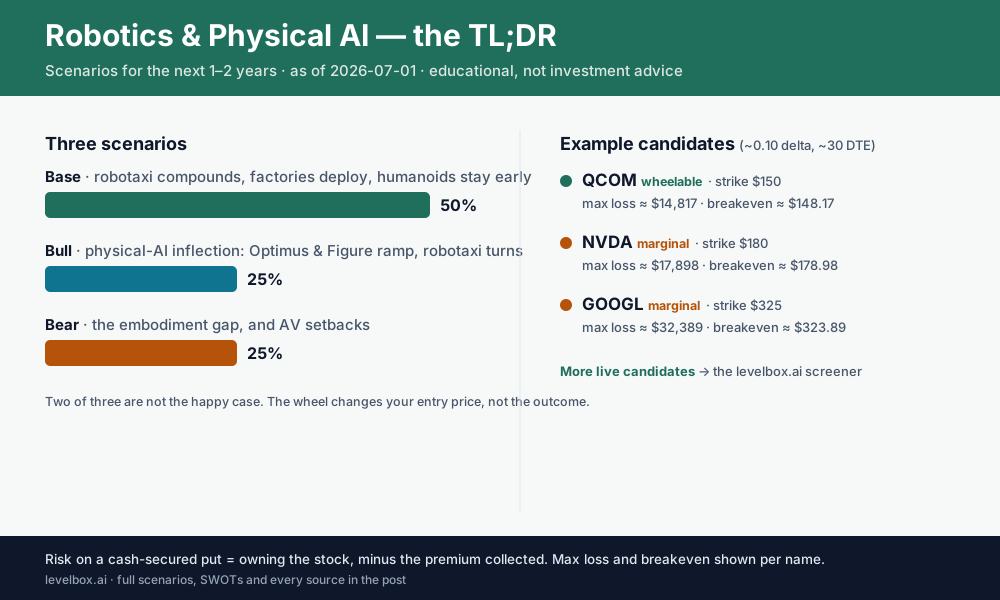
Base — robotaxi compounds, factories deploy, humanoids stay early · 50%
Robotaxi keeps compounding and industrial robots keep deploying into factories, while humanoids stay in pilots rather than mass consumer use.
The drivers: Waymo runs about 3,000 robotaxis with 20M+ trips and targets roughly 1M trips a week by end-2026, expanding toward London and Tokyo; Figure's BotQ line runs at about 1 robot an hour with BMW running 40 units; analysts still project large long-run markets (humanoid ~$165B by 2034, robotaxi ~$400B by 2035). Winners cluster in QCOM, NVDA, ISRG, TER, GOOGL. The laggards are the pre-volume humanoid and lidar pure-plays that need mass production to justify their valuations.
What would break this read: Waymo trip growth stalls, or a serious AV safety incident triggers a regulatory pullback. Watch for those rather than the headlines.
Bull — physical-AI inflection: Optimus and Figure ramp · 25%
Humanoid production inflects and robotaxi economics cross into workable unit costs. The whole stack re-rates up.
The drivers: Tesla's Fremont line is designed for about 1M Optimus units a year, with Giga Texas targeting roughly 10M a year from summer 2027 and a $20–30K consumer price by end-2027; Figure is scaling BotQ toward roughly 100k units a year; Huang's ~$40T framing. Winners broaden to NVDA, QCOM, ARM, TER, MP, plus the sensor names OUST and AEVA.
Invalidation: production ramps slip again — the Optimus V3 reveal has already been pushed — or humanoid unit economics disappoint.
Bear — the embodiment gap, and AV setbacks · 25%
Intelligence keeps outpacing embodiment. Robots stay mechanically fragile, safety and liability frameworks lag, and AV timelines slip again. A safety incident or a funding disappointment deflates the hype, and the speculative pure-plays derate hard.
The numbers behind the worry: modern humanoids are cognitively impressive but mechanically fragile and still need human failure-recovery; McKinsey has AV adoption slipping 2–3 years with L4 cost estimates up 30–100%, on top of prior robotaxi incidents (Cruise, the Tesla pilot); skepticism is rising through 2026. Relative winners are the diversified semis and industrials with real revenue — QCOM, TXN, ADI, ISRG, EMR. Hit first: the pre-volume pure-plays that need the ramp to arrive — AUR, OUST, AEVA, MBLY, SYM.
Invalidation: a clean, audited safety and reliability milestone, or demonstrably profitable robotaxi economics.
Three scenarios, and two of them are not the happy one. Keep that in view before the wheel part. The wheel does not save you from the bear case. It only changes the price you enter at, on names you'd own regardless.
The wheel angle: worked examples rather than a shortlist
The wheel is simple. You sell a cash-secured put on a stock you'd accept owning at the strike, and get paid to wait for your price. If assigned, you own it and sell calls. If not, you keep the premium and repeat. The risk is not exotic: it is owning the stock, minus the premium collected. So the only names worth wheeling are ones you'd hold through a drawdown.
Run against this theme's fact pack at about 0.10 delta and 30 DTE, the striking result is how few names clear the bar. Treat these as worked examples of how the lens scores a candidate rather than a buy list:
| Ticker | Verdict | CSP max loss | Breakeven | Strike / credit |
|---|---|---|---|---|
| QCOM | wheelable | ≈ $14,817 | $148.17 | $150 / $1.83 |
| NVDA | marginal | ≈ $17,898 | $178.98 | $180 / $1.02 |
| GOOGL | marginal | ≈ $32,389 | $323.89 | $325 / $1.11 |
| ARM | marginal | ≈ $24,943 | $249.43 | $255 / $5.57 |
| ISRG | marginal | ≈ $36,284 | $362.84 | $370 / $7.16 |
QCOM is the one name that scores wheelable here. It is the edge-AI "brain" for robots and devices, diversified, and cheap for the quality, with enough premium at the target delta. Max loss on the put is about $14,817, breakeven near $148.17. The other side: Apple is designing out its modem, and handset cyclicality still drives the bulk of revenue.
GOOGL owns Waymo, the robotaxi leader by deployment, funded by a roughly $16B raise at a roughly $126B valuation. It reads marginal on the premium maths: a $1.11 credit on a $325 strike is about 0.3% of the strike at roughly 0.39 implied vol — light for the capital tied up. Max loss about $32,389, breakeven near $323.89. ARM is the royalty toll under almost every robot SoC; the credit is fuller at $5.57, but implied vol near 1.06 makes a wide assignment band on the $255 strike — a large potential move either way against about $24,900 of collateral (max loss ~$24,943, breakeven $249.43). NVDA and ISRG are quality anchors where the credit is thin for the capital: NVDA pays $1.02 on a $180 strike (~0.6%, max loss ~$17,898, breakeven $178.98); ISRG pays $7.16 but ties up about $36,300 (max loss ~$36,284, breakeven $362.84). All are solid businesses — the wheel maths simply reads better on some than others at this delta.
What fits the screen, and what sits outside it
The pure physical-AI plays — the humanoid supply chain and the lidar names OUST and AEVA — mostly did not rank on the wheel lens, and the foreign automation ADRs (ABB, Fanuc, Siemens) sit outside it because they carry no US options. A high-growth, high-momentum name like Tesla is outside the screen's parameters too: the wheel lens is built for value-oriented names you'd be content to own at a discount with steady premium, so a fast-moving momentum profile is simply a different kind of position. That's a statement about fit with the algorithm rather than a view on the company. The theme is a powerful story, and the names the wheel screen fits here are the established enablers.
The method matters more than these five. Run the same screen on a different day, or with a different delta, account size or DTE, and other candidates surface. The useful part is the lens, applied to names you'd genuinely own.
What to do with the speculative names
Keep them on the radar rather than in the wheel. OUST and AEVA are real companies over $2B with growing revenue, and the humanoid ramp is genuine. But pre-volume, high-vol names are where the wheel's math turns against you. The fat premium is the market quoting blow-up risk back to you, and assignment means owning a single-catalyst stock through a drawdown. If the bull case lands, you want them via a small, defined-risk position rather than a put you're forced to honour.
For the current, full list — scored live with fresh numbers, at your own delta and account size — run the levelbox.ai screener.
The one line to remember
Wheel names you'd own outright, at the strike, for years. Everything above is scenarios and math to help you decide which those are. It is not a recommendation to sell any put, and the bear case has a one-in-four weight for a reason. Verify the figures against primary filings before acting.
Sources
Fact pack: deep-dive-analytics (yfinance, as of 2026-07-01, ET) — the wheel scores, IV, and CSP max-loss/breakeven figures. Narrative figures are read via reputable outlets and named research firms; forecasts are projections rather than facts.
- Humanoid market ~$6B (2026) → ~$165B (2034): Fortune Business Insights
- Humanoids framed as a ~$40T market (Jensen Huang): 24/7 Wall St
- Tesla Optimus line / V3 reveal slip: Electrek
- Figure BotQ ~1 robot/hour, BMW 40 units: Interesting Engineering
- Waymo ~3,000 robotaxis, 20M+ trips, city expansion: Electrek
- Robotaxi ~$400B by 2035: Goldman Sachs
- Embodiment gap / hype-vs-reality: IEEE Spectrum
- AV timelines slipping 2–3yr, L4 cost +30–100%: McKinsey (via WEF)
Point-in-time narrative on a reproducible fact pack. Full citations with tiers live in analysis.json and factpack.json.
Common questions
- Are the pure-play humanoid and robotaxi stocks wheelable?
- As of 2026-07-01, mostly not on this lens. In this one fact pack the pure physical-AI plays — the humanoid supply chain and the lidar names OUST and AEVA — mostly did not rank, and the foreign automation ADRs (ABB, Fanuc, Siemens) fell outside it because they carry no US options. A high-growth, high-momentum name like Tesla also sits outside the screen's parameters: the wheel lens is built for value-oriented names you'd be content to own at a discount with steady premium, which is a different profile. That is about fit with the algorithm rather than a view on any company — the names that fit best here are the established enablers.
- Are QCOM, NVDA and GOOGL recommendations?
- No. They are worked examples of how levelbox's wheel screen scored names in a single fact pack on 2026-07-01, used to show the method — quality plus enough premium at the target delta. They are not a buy list, and other names screen differently on a different day or with different inputs (delta, DTE, account size). For a current, fuller list, run the levelbox.ai screener. Nothing here is a recommendation to sell any put.
- What is the risk on a cash-secured put in these names?
- The same as owning the stock, minus the premium. On QCOM the max loss is about $14,817 with a breakeven near $148.17 (strike $150, credit $1.83). On NVDA it is about $17,898, breakeven near $178.98 (strike $180, credit $1.02). On GOOGL about $32,389, breakeven near $323.89 (strike $325, credit $1.11). If the shares fall to zero you lose the strike minus the premium, times 100. Size accordingly.
Read next
- Theme Deep-Dives
AI Value Chain Risk: What Actually Breaks, and Where the Data Already Is
The AI labs are not the fragile part. AI value chain risk sits in the financing built on top of them, and the credit market is already printing the data set.
- Theme Deep-Dives
When Implied Volatility Sits Below Realised: Reading the Memory Names in September 2026
Across a basket of large-cap names the 30-day implied vol is printing below trailing realised vol. That usually reads as underpaid premium. Sometimes it is the options market correctly forecasting that a vol event has passed. How to tell the two apart, measured on 19,485 name-days, and what it looks like on the memory complex right now.
- Theme Deep-Dives
Nuclear Energy: Worth Getting Paid to Buy It at a More Reasonable Price? (as of 2026-09-01)
Big tech has committed 10+ GW to nuclear, but the reactors arrive 2028-2035. We added a nuclear theme to the screener and ran it. Seven of nineteen names never reached the ranking at all, and BWXT, the business everyone points at, came ninth of the twelve that did. Educational; not advice.