The AI Buildout's Second Phase: From Capex to ROI Capture
6 August 2026 · 26 min read
For about a week at the end of July 2026, the market looked like it had turned on AI capital spending. Alphabet raised its capex guidance and fell roughly 7%, dragging the other hyperscalers with it. Then Microsoft reported on 29 July and added about $260 billion of market value in one evening. The narrative flipped that fast. What the market had turned on was never the spending. It wanted proof the revenue behind it was real and broad-based, and that question now splits the AI trade into layers that behave very differently.
We wrote in The AI Buildout, Three Ways on 1 July that this was "a capex story before a demand story," and asked whether the revenue would arrive before the depreciation. Five weeks on, some of it has.
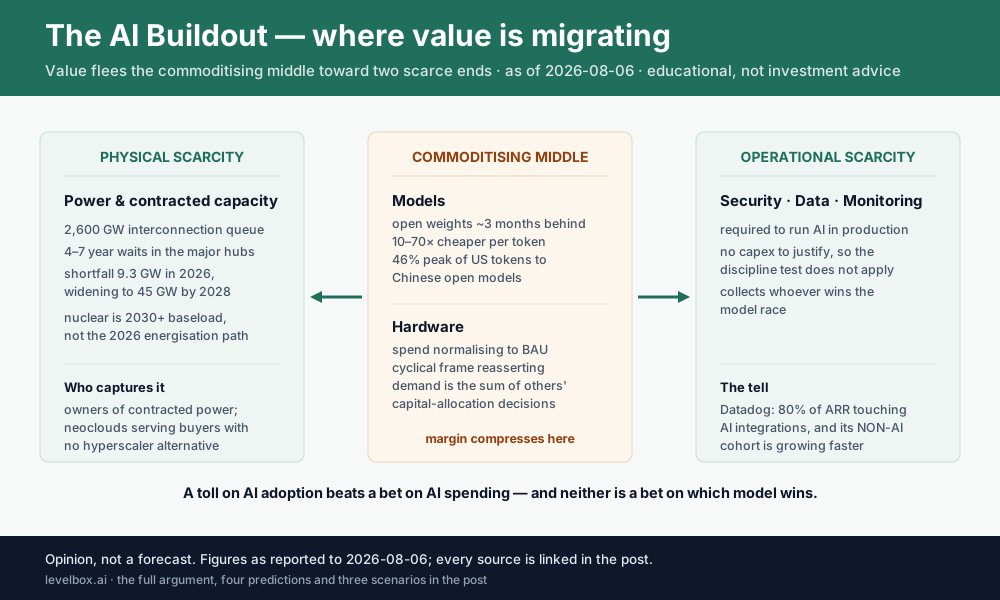
The TL;DR. Models are getting cheap and hardware spend is becoming routine, so the middle of the stack loses pricing power. Scarcity now sits at the two ends. Power and contracted capacity take four to seven years to build, and the operational software you need to run AI in production gets paid whichever model wins.
The sequence, because the order explains it
First, the scare. Alphabet raised full-year capital spending guidance and the stock fell about 7%. Amazon, Meta and Microsoft fell with it. Investors had apparently run out of patience with spending against uncertain returns, a fair reading when the big four had guided to roughly $725 billion of 2026 capex, up 77% on the $410 billion or so they spent in 2025. That view held for about a week.
Then Microsoft, on 29 July. Roughly $260 billion of market value in a single evening. The print did three jobs at once, and Alphabet's had only done two of them.
It grew. Azure and other cloud services grew 43%, pushing Azure past $100 billion of annual revenue for the first time and beating the company's own 39–40% constant-currency guide. Commercial remaining performance obligation grew 84% to $678 billion. Next quarter was guided to 45% constant-currency Azure growth, against a 41.4% consensus.
It explained where the growth came from. Every dollar of the $51 billion sequential increase in commercial bookings came from customers other than the large AI model companies. Backlog grew 25% excluding OpenAI. Copilot seats passed 30 million, up from just over 20 million in April. Those numbers land directly on the loudest bear case in the theme, that AI revenue is substantially circular, with hyperscalers booking sales to model companies they have themselves funded. Strip OpenAI out and the backlog still grows 25%. That is ordinary enterprise demand, the thing the capex was supposed to be for.
And it showed discipline on the spending. Here is where the print pulled away from Alphabet's. Microsoft spent $35.80 billion on property and equipment in the quarter, more than double the $17.08 billion a year earlier, taking fiscal-year capex to $115.95 billion and up nearly 80%. CFO Amy Hood then described the shape of that spend, not just its size. About two-thirds goes to short-lived assets, CPUs and GPUs with short lead times, so if demand softens the biggest line can simply be slowed. Land and buildings take a smaller share and their timing is flexible. The fleet moves across geography, segment and workload, and a large first-party application business can soak up the same capacity.
An options trader will recognise the structure. Two-thirds of that spend is a string of short-dated commitments, not one long-dated bet. The number did not get smaller. It got a throttle. Alphabet raised its budget and asked for trust; Microsoft raised its budget and showed the exit. The market paid for the exit.
Then the confirmation. AWS revenue rose 37% year over year to $42.2 billion, its fastest in eighteen quarters, with Amazon's AI and chip businesses each running near $25 billion a year. Google Cloud accelerated to 82% growth at $24.8 billion. Alphabet raised full-year capex again, to $195–205 billion, the same move that had cost it 7% a week before. Microsoft closed the week up roughly 27% and Amazon roughly 20%, taking Amazon past a $3 trillion market capitalisation. Meta rallied about 7%. Alphabet recovered its drop in full and now sits up around 20% year to date, on roughly 17 times earnings against 82% cloud growth.
And separately, Palantir. On 3 August: revenue up 93% year over year, EPS of $0.41 against a $0.28 consensus, a ninth straight beat, US commercial revenue up 149%. The stock closed 29.5% higher at $162.66 the next day. It also trades near 43 times projected 2026 sales, which belongs in the same paragraph as the growth.
What it means layer by layer
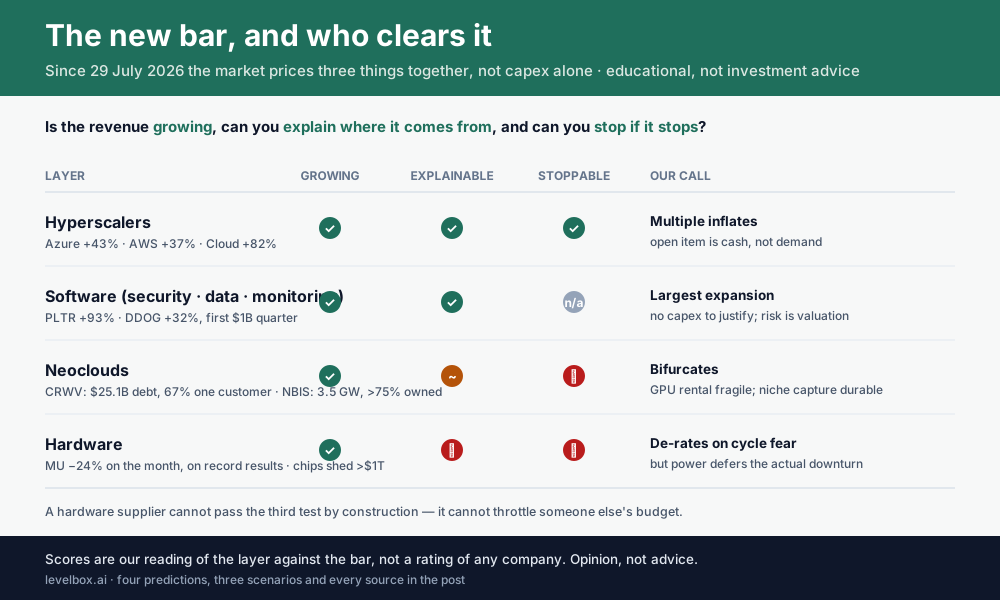
Three questions now decide how a name gets priced. Is the revenue growing? Can you explain where it comes from? Can you stop if it stops? Run the AI trade through those and it separates into four groups that usually get discussed as one.
Hyperscalers: re-rated, and the argument has moved to cash
They clear all three. They own the end customer. They can account for demand without leaning on the AI labs. Microsoft spelled out the throttle. And Alphabet raised capex again inside the same fortnight and got paid for it, which tells you the bar moved and the budget did not.
Their open question is no longer demand. It is conversion. Alphabet's Q2 free cash flow came in at negative $5.9 billion. Amazon's trailing twelve-month free cash flow is negative $7.6 billion after $54.2 billion of quarterly capital spending. Microsoft's fell about 23% over the year. These are the same companies whose revenue growth drove the rally. Revenue has arrived; cash has not followed yet. Infrastructure normally works that way, and it is also the first thing that gets questioned if growth slows.
Software: the layer actually capturing the return
Palantir and Datadog monetise AI without building it. There is no capex to throttle, so the third question barely applies to them. Palantir grew revenue 93%, with US commercial up 149%. Datadog passed $1 billion in a quarter for the first time, up 32%, and lifted full-year guidance to $4.3–4.34 billion. Around 20% of its customers now use AI integrations, and those customers carry 80% of ARR.
Sit with one number inside that mix. Datadog's non-AI customer revenue accelerated to mid-20% growth year over year, while its AI-native cohort grew only high single digits. Now put that beside Microsoft's disclosure that its whole $51 billion bookings increase came from outside the AI labs. Two companies with no reason to coordinate are describing the same thing: the durable money is ordinary enterprises folding AI into work they already do, not AI-native firms spending venture funding.
It is a duller story than the one the theme usually tells, and a more investable one. The risk here is the price, not the demand. Palantir at roughly 43 times projected 2026 sales leaves no room for a stumble, and consumption pricing works in both directions, since revenue that grows with workloads also shrinks with them.
Neoclouds: built the opposite way to what got Microsoft re-rated
CoreWeave and Nebius fail the third question by design, which is where this framework bites hardest.
Microsoft got paid for a fungible fleet, two-thirds short-lived assets and a diversified customer book. A neocloud is a single-purpose GPU estate, financed with debt, sold to very few buyers. CoreWeave raised 2026 capex guidance to as much as $35 billion and closed Q1 with $25.1 billion of debt plus $10.1 billion of operating lease liabilities. Its 56% adjusted EBITDA margin shrinks to a 1% adjusted operating margin once depreciation and amortisation land, and $536 million of net interest expense fed a $740 million net loss. It buys its GPUs from one supplier.
Then there is the concentration. Microsoft was 67% of CoreWeave's 2025 revenue, the top three are expected to stay above 80% even after diversification, and one Nebius customer has been reported as high as 83% of year-end revenue.
Set those two facts side by side and the problem is obvious. CoreWeave's dominant customer is the company that just told the market it can slow its largest capex line whenever demand shifts, and got applauded for saying so. The throttle Microsoft was re-rated for owning points straight at the neocloud's revenue. A neocloud is precisely the long-dated, non-fungible, single-purpose bet Microsoft said it was avoiding.
They are not one trade, though, and treating them as one is its own mistake. Nebius grew Q1 revenue 684% to $399 million with AI revenue up 841%, swung adjusted EBITDA to a $129.5 million profit from a $53.7 million loss, and carries a far more manageable debt-to-equity ratio.
There is also a bull case the concentration critique misses, because that critique assumes the customer stays an AI lab. Private and sovereign AI is the emerging use case, and hyperscalers are structurally bad at serving it. Regulated industries and governments need local data processing and jurisdictional control, and multi-tenant global cloud is the wrong shape for that. Worldwide sovereign cloud IaaS spending should reach roughly $80 billion in 2026, up about 35.6% on 2025. Gartner calls the shift geopatriation and expects around 20% of existing workloads to move from global hyperscalers to local or regional providers. The neocloud segment is projected to compound at roughly 82% a year over five years, reaching about 20% of a $267 billion AI cloud market by 2030.
That changes what the asset is. The same GPU estate looks like a concentrated single-purpose bet when it is rented to three AI labs, and like contracted national infrastructure when it is sold to governments and regulated enterprises with no hyperscaler option at all. What separates the two is the customer list, and whether the provider owns the capacity underneath.
The customer list that matters is narrower and better than "enterprise". Governments buying sovereign capacity. Research institutions that need long uninterrupted bare-metal runs, where abstracted multi-tenant instances get in the way. Quant funds that will not put alpha-generating models on shared infrastructure at any price. All three share the quality that fixes the margin problem: their requirements are inflexible and their price sensitivity is low. A hyperscaler's product is not expensive for them, it is simply wrong. Wrong jurisdiction, wrong abstraction layer, wrong tenancy model. Discounts do not fix wrong.
That is a different business from commodity GPU rental and it should earn different economics. CoreWeave's 1% adjusted operating margin is what renting undifferentiated capacity to sophisticated buyers at scale looks like. Selling dedicated, compliant, isolated capacity to a buyer with a mandate and no alternative is premium pricing on the same silicon. Which business a provider is actually in gets answered by its customer list, not its fleet size. On the ownership half, Nebius is the cleaner expression: contracted power passed 3.5 GW in Q1 2026, with more than 75% of that capacity owned outright. Owning it buys control of site economics, delivery timing and long-run margin. Leasing it means renting your own cost base.
Hardware: demand is everyone else's capex, added up
The chip and memory names sit furthest from the end customer. Their revenue is the arithmetic sum of capital-allocation decisions taken in the three layers above, which is why they were sold in the same fortnight the hyperscalers rallied. Sandisk fell about 14%, AMD and Seagate about 8%, Western Digital about 7%, Intel about 6%. Chip stocks shed more than $1 trillion. Micron dropped roughly 24% over the month to 30 July on record fiscal Q3 results with HBM4 shipping in volume. Samsung came in short of a high AI bar and SK Hynix fell hard.
We looked at these same names when their premium was the story in fat premium and the memory bottleneck; the layered view makes the risk sharper than "AI capex might slow". Hyperscaler capex is enormous and now openly throttleable. Neocloud capex is debt-financed and concentrated in a few buyers whose own revenue is concentrated in a few customers. Hardware demand is the total, so the first dollar to disappear is the marginal one, and the marginal dollar is a neocloud dollar.
In one fortnight, every layer that could point at its own revenue line got paid: cloud, AI software, the hyperscalers' own chip businesses. The layer that could only point at its customers' spending got marked down.
The hypothesis
The buildout is moving out of a phase where spending was the evidence and into one where earning is, and the market is sorting the theme by how close a company sits to revenue it can demonstrate.
Through 2025, announcing a bigger capital budget was itself bullish. It signalled balance sheet, power contracts and chip allocation, and it implied demand the company could not yet serve. The market paid for intent.
In 2026 intent stopped being enough on its own. The Alphabet reaction was the market testing whether capex alone still earned a bid, and for a week the answer came back no. What restored it was not a smaller budget but a better-argued one: growth, a demand story that survives having the AI labs stripped out, and a capital plan with a stated brake. Alphabet then raised capex again in the same fortnight and got paid, which is about as clean a demonstration as you get that the question was repriced and the number was not.
The bar moved from "how much are you spending" to three things at once. Is the revenue growing? Can you explain where it comes from? Can you stop if it stops?
Hardware sits one step further out. Its revenue derives from someone else's capital-allocation decision, so it carries capex risk without owning the customer relationship that would eventually justify that risk. When the market wants proof, a supplier can only offer proof that its buyers are buying, and that is exactly the claim under examination.
Five forces underneath it
The predictions below make sense only against the structural drivers producing them. Five matter, and together they describe value draining out of the middle of the stack toward both ends.
Model commoditisation, accelerated by Meta and the Chinese labs. Open-weight models from DeepSeek, Alibaba's Qwen, Moonshot's Kimi and Z.ai's GLM now ship under MIT and Apache licences, and Epoch AI's tracking puts them roughly three months behind the state of the art. That is the smallest gap ever measured. Pricing followed. DeepSeek V4 Pro runs $0.435/$0.87 per million tokens against Claude Opus 4.8 at $5/$25 and GPT-5.5 at $5/$30, roughly ten times cheaper at the top tier and up to seventy at the flash tiers. US companies routed more than 30% of their OpenRouter tokens to Chinese open models every week from February 2026, peaking at 46%, against a twelve-month average near 11% and just 4.5% in the first half of 2025. Durable margin does not accrue to a layer converging on commodity pricing.
Hyperscalers taking AI budget out of corporate IT. This generalises Microsoft's disclosure. If bookings growth comes from outside the AI labs, the money is migrating from IT budgets that already existed, not arriving as a separate AI allocation. The addressable market is therefore corporate IT, and the growth mechanism is upselling an installed base. Both favour whoever already owns the enterprise relationship.
Software turning from optional into required. Covered above, and the first force reinforces it. As models commoditise, what you wrap around them becomes the differentiator.
Hardware spend settling into business as usual. This one most changes how the cycle should be read. The buildout is becoming a standing line item instead of a surge. Cyclicality is real, but the downturn sits further out than current fear implies, which is why we expect multiples to compress on cycle anxiety long before any earnings cycle shows up.
Power as the binding constraint, with no near-term way around it. US data centre power demand runs around 75.8 GW in 2026, up from 61.8 GW in 2025 and projected at 134.4 GW by 2030. Goldman Sachs puts the structural shortfall at 9.3 GW in 2026, widening to 45 GW by 2028. The interconnection queue has passed 2,600 GW, average waits approach five years, and withdrawal rates sit near 80%. New high-capacity connections in Northern Virginia, Dublin, Singapore and Amsterdam face four to seven year waits. Hyperscalers have committed to nearly 10 GW of nuclear and SMR capacity since 2023, including Microsoft restarting Three Mile Island Unit 1, Meta contracting 1,100 MW at Clinton and AWS signing three separate agreements. All of it belongs to the 2030-plus baseload layer, well outside the 2026 energisation path. Nuclear is coming and is not ready. Quantum is further away still.
That last force reorders the rest. If electrons rather than chips set the pace, the buildout runs on a physics schedule with a multi-year lag. That defers the hardware downturn and makes contracted power the scarcest asset in the theme. It also explains why the neocloud conversation stopped being about GPU counts and became about power.
Put the five together and you get value draining from a commoditising middle toward two scarce ends. At the physical end, power and contracted capacity cannot be conjured inside four years. At the operational end, the software you need to run AI in production gets paid whoever wins the model race.
Where we think this goes
Four predictions follow. They are opinions, not measurements, and each one names what would prove it wrong.
One: hyperscaler multiples inflate, not just their earnings. The re-rating so far has been the market paying for one delivered quarter. The bigger move, if the ROI question keeps resolving, hits the multiple itself, as a business priced for capex risk gets repriced for durable AI revenue. Alphabet on roughly 17 times earnings against 82% cloud growth is the clearest version of that gap. Those two numbers do not usually sit together and one of them has to give. Wrong if free cash flow stays negative into decelerating cloud growth, in which case the multiple compresses instead and the cash burn becomes the headline.
Two: cyclicality fears intensify for hardware and compress the multiple, while the actual downturn stays years out. Those are two separate things and keeping them separate is the whole call. Memory and storage have always been cyclical businesses that the AI narrative briefly re-rated as secular, and the cyclical frame is already reasserting itself. The reported quarters since then argued the other way, and we went through what survived and what did not in when implied volatility sits below realised. Micron fell roughly 24% on the month while posting record results. There is an irony in Microsoft's print here: the disclosure that made it bullish for Microsoft is bearish for its suppliers. "About two-thirds of our capex is short-lived assets we can slow down" is the last thing a cyclical supplier wants its biggest customer saying out loud, to applause.
Anxiety about a cycle is still not a cycle. Spend is settling into a standing line item, and the power constraint puts a multi-year floor under demand that no capex decision can accelerate through. A 2,600 GW interconnection queue with five-year average waits means a large stock of committed, un-energised demand arriving on a physics schedule that sentiment cannot move. So the multiple should compress on cycle fear well before earnings confirm anything, which is an awkward combination to hold: de-rating on good numbers. Wrong if memory stays genuinely supply-constrained and the market gives it credit, or if the earnings downturn arrives much sooner than the power pipeline suggests.
Three: the software AI depends on, meaning security, data and monitoring, takes the largest multiple expansion of any layer. This is the least discussed of the four and, we think, the strongest.
The reason is structural. You cannot run AI in production without observability, without security, and without somewhere to put the data. That makes this layer a toll on AI adoption instead of a bet on AI spending, and adoption is what both Microsoft and Datadog just reported accelerating outside the AI-native cohort. There is no capex to justify, so the discipline test now punishing infrastructure does not touch it. Consumption and seat pricing scale with workloads that get created whoever wins the model race. And it collects whether the AI application belongs to a hyperscaler, a neocloud customer or an enterprise itself.
Datadog is one company's version of this: 80% of ARR on customers using AI integrations, seven- and eight-figure land deals with hyperscaler research divisions, and a non-AI cohort that is accelerating. The category runs wider than any one name, across observability and monitoring, cloud security, and the data platforms underneath both. Wrong if the same AI creating these workloads also automates the tooling that watches them, or if consumption pricing cuts harder on the way down than seat-based models did in 2022.
Four: neoclouds split in two instead of moving together. The layer trades as one thing today and is about to stop. GPU rental to a handful of AI labs, debt-financed on leased capacity, is the fragile half. It is the long-dated non-fungible bet Microsoft said it was not making, sold to customers who can stop buying.
The durable half is niche capture. Governments, research institutions and quant funds buying dedicated, compliant, isolated capacity. Those buyers have inflexible requirements and low price sensitivity, their contracts run long, and their demand follows compliance calendars and research programmes, so it does not evaporate when a lab misses a funding round. It is premium pricing rather than commodity pricing, which is the only credible way out of the margin structure the fragile half is stuck in. What separates the halves is customer concentration and owned-versus-leased capacity, not GPU count. In a market where new interconnection takes four to seven years, contracted power is a moat and not a line item. Nebius passing 3.5 GW with more than 75% owned reads very differently once you know the queue is 2,600 GW deep. Wrong if hyperscalers manage to build sovereign-compliant regional offerings at scale, which they are certainly trying to do, and geopatriation turns out to be a product feature instead of a structural opening.
Three scenarios, and what each does to the predictions
A prediction with no falsification condition is just confidence. So here are the three ways the next twelve to eighteen months plausibly run, what each does to the calls above, and the markers that tell you which one you are in before the multiples move. The probabilities are our judgement and not a model output.
Scenario A — Adoption compounds (our base case)
Enterprise AI adoption keeps broadening. Cloud growth holds in the 30%+ range, capex growth decelerates while revenue growth does not, and free cash flow inflects positive during 2027 as the revenue catches the spending.
- Prediction 1 (hyperscaler multiples): supported. This is the scenario the 17-times-earnings gap closes upward in.
- Prediction 2 (hardware cyclicality): partially disproved. Volumes stay strong. The multiple probably stays cyclical anyway, because a customer who says he can slow down has already told you his terms.
- Prediction 3 (software toll): strongly supported. Adoption is the toll base, and this is the scenario where it compounds.
- Prediction 4 (neocloud bifurcation): supported, slowly. A rising tide funds both kinds. The split shows up in contract quality and customer mix long before it reaches the price.
Scenario B — The throttle gets used
Demand disappoints somewhere in 2027. Hyperscalers do exactly what Amy Hood described: slow the short-lived asset purchases, stretch the land and buildings, and let the fungible fleet absorb the gap. Capex guidance comes down without a crisis.
- Prediction 1: disproved. Decelerating growth against still-negative free cash flow is where the multiple compresses instead of expanding.
- Prediction 2: strongly supported. Hardware is the first casualty by construction, and the memory cycle turns hard.
- Prediction 3: the real test. Adoption slows but does not reverse, and workloads already in production still need monitoring, security and somewhere to put the data. The toll shrinks; it does not stop. If this layer's revenue proves resilient here while hardware halves, prediction 3 is doing exactly what we claim.
- Prediction 4: strongly supported. This is where the split becomes visible. Sovereign and regulated demand is driven by compliance calendars rather than model economics, so it keeps buying while AI-lab rental does not.
Scenario C — The circular loop breaks
The AI-lab funding chain seizes. A concentrated neocloud customer defaults or renegotiates, debt service becomes the story, and the forced-seller dynamics reach the suppliers.
- Prediction 1: mixed. Hyperscalers become the safe haven on relative quality while their multiples compress on sentiment. Directionally wrong even where the underlying reasoning holds.
- Prediction 2: violently supported, and the fastest of the three scenarios to express.
- Prediction 3: supported in relative terms only. Least exposed does not mean unexposed, and a multiple-compression event is indiscriminate for a quarter or two regardless of business quality.
- Prediction 4: supported, painfully. The bifurcation resolves through a credit event rather than a re-rating, which is a very different experience for holders even when the eventual call is right.
The markers worth watching
These are observable before the re-rating, which is what makes them useful rather than descriptive.
| Marker | Scenario A | Scenario B | Scenario C |
|---|---|---|---|
| Hyperscaler capex guidance revisions | still rising | first cuts | cuts plus withdrawn guidance |
| Free cash flow at MSFT / GOOGL / AMZN | inflects positive during 2027 | stays negative into slowing growth | deteriorates sharply |
| Backlog growth excluding the AI labs | holds above 20% | decelerates | reverses |
| DRAM and NAND contract pricing | firm on real shortage | rolls over | collapses |
| Neocloud debt spreads and refinancing terms | normal | widening | the event itself |
| Software consumption growth and net retention | accelerating | decelerating but positive | negative for a quarter or two |
| Neocloud customer concentration and owned-vs-leased capacity | concentration falling, owned share rising | mixed | concentration exposed |
| Sovereign cloud spend and geopatriation share | tracking the ~$80B 2026 path | slows with budgets | continues, it is compliance-driven |
| Datadog's non-AI cohort versus AI-native cohort | non-AI keeps leading | both slow together | both negative |
Watch the third line hardest. Backlog growth stripped of the AI labs is what turned the narrative on 29 July, and it will turn it back if it goes. Companies only started disclosing it recently, so check each quarter that they still do.
We ran a fuller three-scenario version of this theme in The AI Buildout, Three Ways. This is that exercise again, after the market began answering.
Where the question has moved to
All four layers now share one open item, and revenue is no longer it. Cash is, and the order in which it shows up.
Here is the honest state of the ROI question in early August 2026. Revenue is arriving. Cash is not, yet. The market has chosen to pay for the first while the second is outstanding. Infrastructure normally gets built before the cash flow that services it, as railways, fibre and cloud all did, so that is a defensible choice. It is also the first assumption that gets tested if growth slows, and the layers do not carry that test equally. A hyperscaler funding negative free cash flow out of an enormous operating business is in a very different position from a neocloud funding it with $25 billion of debt against three customers.
What would falsify this
One fortnight is not a regime. Money rotating from hardware into software and cloud inside the same theme looks exactly like a phase change for a few weeks, then resolves as neither.
Memory may be genuinely supply-constrained. Micron's record quarter and its HBM4 volumes describe a shortage. A supply-constrained business selling into a capex scare is a different animal from one carrying excess capacity, and confusing the two is the easiest mistake available here. Micron was also up more than 600% over the prior year, so a 24% drawdown is a large move on a much larger run.
The cash gap may close on its own. Depreciation schedules and revenue ramps are not designed to land in the same quarter. Negative free cash flow during a build tells you a build is happening, and little else.
What this means for selling puts on these names
Here is where the phase transition stops being editorial.
Selling cash-secured puts wants two things at once: rich implied volatility, and a decent chance the stock is higher in a year. Right now the hardware layer offers the first while the second is under active dispute. In our own snapshot on 6 August 2026, several screened AI hardware names carried implied volatility between roughly 87% and 121%, against a market reading near 13.5%. That is some of the richest premium in our universe, and it is rich precisely because the outcome is contested. Nobody pays triple-digit implied vol on a settled question. What that premium is worth also depends on the market regime you are selling into.
Assignment is not the hazard. Being assigned is how the wheel works, and ending up owning a good business at a lower basis is the point of it. The hazard is a falling knife: a name whose fundamentals still read well after the tape has broken. "Record results, down 24% on the month" is that description exactly, and it is the same trap as mistaking a cheap price for a margin of safety. Our screen flags the combination, trading below the 200-day average with weak momentum, because strong fundamentals are what talk you into catching one.
Two things follow. Size smaller than usual, since a dollar of premium collected at 100% implied volatility carries far more downside than the same dollar at 30%. And do not underestimate the correlation inside this theme. A book of memory, storage and AI-infrastructure puts is one position wearing several tickers, and it will not diversify you in the scenario where the capex question resolves badly. Stocks carry tail risk too, and a correlated book concentrates it. The hyperscalers rallying while their suppliers fell should be enough of a reminder that "AI exposure" is not a single exposure.
The honest summary
One earnings season, evidence a few weeks old. What can be said confidently is narrower than the headline. In late July 2026 the market repriced AI capital spending downward for about a week. Microsoft's 29 July print reversed that by showing demand growing outside the AI labs. The hardware layer got left behind in both directions. And free cash flow went negative at the same companies whose revenue drove the rally.
Our view, offered as opinion. Hyperscaler multiples inflate as the ROI question resolves. Hardware gets repriced as the cyclical business it always was. The software AI depends on, meaning security, data and monitoring, captures the adoption without carrying any of the capex. And neoclouds split into a fragile half renting GPUs to model labs and a durable half selling dedicated capacity to governments, research institutions and funds, for whom a hyperscaler is not expensive but simply wrong. The first two are directional calls on multiples. We would defend the third hardest, because it never requires guessing who wins the model race. The fourth is the one most likely to prove right in substance and brutal in timing.
If you are selling premium into this, the forecast is not the useful part. The useful part is that implied volatility on AI hardware is pricing a real disagreement, that the disagreement concerns someone else's budget and not the company's own execution, and that being right about direction tells you nothing about the path taken to get there.
Update, 6 September 2026: a month on, the interesting question stopped being which layer earns the return and became who absorbs the damage if it does not arrive. The labs turned out to be the healthy part of the chain; the fragility sits in the financing written against them, and the credit market is already printing it. See AI Value Chain Risk: What Actually Breaks.
Analytical and educational, not investment advice. Figures are as reported in the sources below and were current as of 6 August 2026; implied volatility readings are our own snapshot on that date and move daily. Selling a cash-secured put obliges you to buy the stock at the strike, so the maximum loss is the strike less the premium received, per contract, and it is realised in the scenario where the name falls hardest. Do your own work.
Sources: CNBC on Microsoft's Q4 FY2026 result · The Register on the capex shape and Amy Hood's commentary · CNBC on the initial capex scrutiny · Yahoo Finance on the hyperscaler surge · 24/7 Wall St on Amazon passing $3T · Yahoo Finance on the repricing and free cash flow · CNBC on Palantir Q2 2026 · CNBC on the $1T chip selloff · CNBC on AMD, Intel and Micron · Datadog Q1 2026 results · Goldman Sachs and grid-constraint analysis on data centre power · CSIS on Chinese AI models · Computer Weekly on neoclouds and sovereign clouds · ABI Research on neocloud trends · io-fund on neocloud circular financing · Motley Fool on CoreWeave vs Nebius · Forbes on the capex-to-revenue gap
Common questions
- Is the AI buildout moving from investment to ROI capture?
- The late-July to early-August 2026 sequence looks exactly like that, and it turned on one print. Alphabet raised capital-spending guidance, fell about 7% and dragged the other hyperscalers down with it. That scepticism held about a week. Then Microsoft reported on 29 July and added roughly $260 billion of market value in one evening, by delivering three things at once. It grew: Azure up 43% and past $100 billion of annual revenue, commercial RPO up 84% to $678 billion. It explained the growth: every dollar of the $51 billion sequential bookings increase came from customers other than the large AI model companies, and backlog grew 25% even with OpenAI stripped out. And it showed discipline: about two-thirds of capex sits in short-lived CPU and GPU assets that can be slowed if demand shifts, on a fleet that moves across workloads. AWS at 37% and Google Cloud at 82% then confirmed it. The bar moved from how much you spend to whether the revenue grows, whether you can explain it, and whether you can stop.
- Why did chip and memory stocks fall while the hyperscalers rallied?
- They can show that their customers are buying, but not their own end-market revenue, and that is a second-order claim in a phase where the market wants proof. Micron fell about 24% over the month to 30 July on record fiscal Q3 results with HBM4 shipping in volume. In late July Sandisk fell about 14%, AMD and Seagate about 8%, Western Digital about 7%, and chip stocks shed more than $1 trillion across the selloff. A hardware supplier's revenue derives from someone else's capital-allocation decision, so it carries the capex risk without owning the customer relationship that would eventually justify that risk.
- What is the AI capex-to-revenue gap, and is it closing?
- It is the difference between what gets spent building AI infrastructure and what the ecosystem earns back. Estimates put it near $600 billion annually as of 2025, against combined 2026 hyperscaler capex plans of roughly $725 billion. On revenue the gap is closing fast: AWS growing 37%, Google Cloud 82%, Microsoft AI past a $37 billion run rate. On cash it is not closing at all. Alphabet's Q2 free cash flow came in at negative $5.9 billion. Amazon's trailing twelve-month figure is negative $7.6 billion after $54.2 billion of quarterly capex. Microsoft's fell about 23% for the year as capex more than doubled. Revenue arrived first and cash has not followed, and that is the honest state of the question.
- Are neocloud providers like CoreWeave and Nebius exposed differently from hyperscalers?
- Structurally yes, and in the direction the 2026 repricing punishes. Microsoft was re-rated partly for a fungible fleet, roughly two-thirds short-lived assets it can slow, and a diversified customer book. A neocloud is close to the inverse: a single-purpose GPU estate, debt-financed, sold to very few buyers. CoreWeave guided 2026 capex to as much as $35 billion and closed Q1 with $25.1 billion of debt plus $10.1 billion of operating lease liabilities. Its 56% adjusted EBITDA margin becomes a 1% adjusted operating margin after depreciation, and $536 million of net interest expense sits inside a $740 million net loss. Microsoft was reportedly 67% of its 2025 revenue, so its largest customer is the company that just proved it can throttle its own spending. They are not all alike, though, and the split runs by customer and not by fleet. Nebius grew Q1 revenue 684% to $399 million, swung to a $129.5 million adjusted EBITDA profit, carries a far more manageable debt-to-equity ratio, and passed 3.5 GW of contracted power with more than 75% of it owned. The durable version of this business is niche capture: governments, research institutions and quant funds buying dedicated, compliant, isolated capacity. Their requirements are inflexible and their price sensitivity is low, because a hyperscaler's product is not expensive for them, it is wrong. That is premium pricing on the same silicon, and a different business from renting undifferentiated capacity to AI labs at a 1% operating margin.
- How does this phase affect selling cash-secured puts on AI hardware names?
- It pulls apart the two halves of a wheel thesis. Selling puts wants rich implied volatility alongside a decent chance the stock is higher later. This phase supplies the first while actively disputing the second. In our own snapshot on 2026-08-06, several screened AI hardware names carried implied volatility between roughly 87% and 121% against a market reading near 13.5%. That premium pays you for a genuine disagreement about someone else's budget. It is not free money. The hazard here is a falling knife: a name whose fundamentals still read well after the tape has broken, and record results alongside a 24% monthly drawdown is that description exactly.
Read next
- Theme Deep-Dives
AI Value Chain Risk: What Actually Breaks, and Where the Data Already Is
The AI labs are not the fragile part. AI value chain risk sits in the financing built on top of them, and the credit market is already printing the data set.
- Theme Deep-Dives
When Implied Volatility Sits Below Realised: Reading the Memory Names in September 2026
Across a basket of large-cap names the 30-day implied vol is printing below trailing realised vol. That usually reads as underpaid premium. Sometimes it is the options market correctly forecasting that a vol event has passed. How to tell the two apart, measured on 19,485 name-days, and what it looks like on the memory complex right now.
- Theme Deep-Dives
Nuclear Energy: Worth Getting Paid to Buy It at a More Reasonable Price? (as of 2026-09-01)
Big tech has committed 10+ GW to nuclear, but the reactors arrive 2028-2035. We added a nuclear theme to the screener and ran it. Seven of nineteen names never reached the ranking at all, and BWXT, the business everyone points at, came ninth of the twelve that did. Educational; not advice.