The AI Buildout, Three Ways: Scenarios and Example Wheel Candidates (as of 2026-07-01)
1 July 2026 · 6 min read
As of 2026-07-01. Educational and analytical only. Not investment advice. Numbers below come from a reproducible fact pack (yfinance, 2026-07-01, ET); the scenarios are point-in-time judgment on top of that data. Nothing here is a buy or sell instruction. Where a cash-secured put is mentioned, its max loss and breakeven are stated.
This article was generated by AI — levelbox's deep-dive tooling — and lightly reviewed. The data is point-in-time and can be wrong; if you spot a mistake, please tell us.
The AI buildout is a capex story before it is a demand story. Google, Amazon, Microsoft and Meta have guided to roughly $725B of capital spending in 2026, up 77% on 2025, and the constraint they all describe is supply rather than demand. Power is the binding input. Memory is the second. Underneath both sits the question nobody has settled: does the revenue show up before the depreciation does.
That tension is the whole thing. Capex you can see today. Return you can only project. So this piece walks three ways the next one to two years can go, then uses a few names as worked examples of how the wheel lens scores a candidate — and at what risk.
Three scenarios
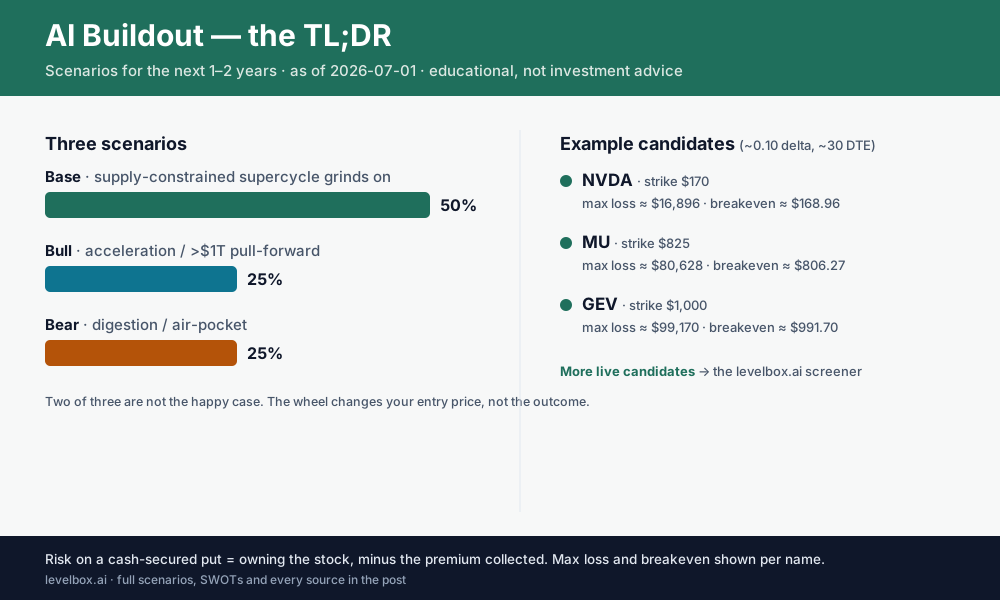
Base — the supply-constrained supercycle grinds on · 50%
Capex holds near guidance and tracks toward the >$1T that Evercore and BofA pencil in for 2027. The market stays supply-constrained. Power and memory stay tight.
The drivers: 2026 capex around $725B (AMZN ~$200B, MSFT ~$190B, GOOGL $175-185B, META $115-135B); hyperscalers reporting they are supply-constrained rather than demand-constrained; nuclear PPAs (Constellation-Microsoft, Vistra-Amazon/Meta) locking multi-year power demand; data centres now taking more than 50% of DRAM/NAND. Winners cluster in NVDA, MU, GEV, plus AVGO, CEG, VST, VRT. The laggards are low-moat suppliers with no pricing power.
What would break this read: a hyperscaler trims 2027 capex guidance on an earnings call, or cloud backlog growth slows two quarters running. Watch for those rather than the headlines.
Bull — acceleration, >$1T pulled forward · 25%
Inference demand inflects, 2027 capex is guided above $1T sooner than expected, and power and memory deals accelerate. The whole enabler stack re-rates up. The tell here is neocloud backlog: CoreWeave reported a $99.4B backlog in Q1'26. Winners broaden to MU, NVDA, VRT, CRDO, ALAB, CRWV, NBIS.
Invalidation: capex intensity moderates toward historical norms, or frontier-model training orders visibly slow.
Bear — digestion / air-pocket · 25%
The ROI gap and depreciation drag force a pause. One hyperscaler trims, overbuild fears surface, the memory cycle rolls over. A sharp, sentiment-driven derating, even if long-run demand is intact.
The numbers behind the worry: roughly 95% of enterprise AI projects show no measurable ROI; GPUs have a 3-5 year life and depreciate about 20% a year — near $400B of annual expense, above combined hyperscaler profits; capex intensity around 34% of revenue, roughly double the 1990s internet peak, with cash generation turning negative. Relative winners in this case are the names with the strongest balance sheets and steadier demand — MSFT, GOOGL, AVGO, CEG, VST. Hit first: SMCI, CRWV, NBIS, MU, WDC.
Invalidation: capex reaccelerates, or enterprise-AI ROI evidence broadens clearly.
Three scenarios, and two of them are not the happy one. Keep that in view before the wheel part, because the wheel does not save you from the bear case. It only changes the price you enter at.
The wheel angle: three worked examples
The wheel is simple. You sell a cash-secured put on a stock you'd accept owning at the strike, and get paid to wait for your price. If assigned, you own it. If not, you keep the premium and repeat. The risk is not exotic: it is owning the stock, minus the premium collected. So the only names worth wheeling are ones you'd hold through a drawdown.
To show how the wheel lens reads a candidate, here are three names from this one fact pack — quality plus enough premium at ~0.10 delta, ~30 DTE. Treat them as worked examples rather than a buy list:
| Ticker | Verdict | CSP max loss | Breakeven | Strike / credit |
|---|---|---|---|---|
| NVDA | wheelable | ≈ $16,896 | $168.96 | $170 / $1.04 |
| MU | wheelable | ≈ $80,628 | $806.27 | $825 / $18.73 |
| GEV | wheelable | ≈ $99,170 | $991.70 | $1,000 / $8.30 |
NVDA is the demand centre of the buildout, with a full-stack moat spanning CUDA, interconnect and systems, well beyond the silicon. The other side: revenue is concentrated in the same hyperscalers whose capex could pause, custom silicon (TPU, Trainium, MTIA, MAIA) chips away at merchant-GPU share, and implied vol around 0.38 says the market already prices big moves. Max loss on the put is about $16,896, breakeven near $168.96.
MU has the richest premium in the sleeve (IV ~0.95), because HBM/DRAM is a genuine bottleneck and memory is deeply cyclical commodity at the same time. It rolls over first in a digestion scenario. A put at the $825 strike ties up about $82.5k of collateral against a ~$1,154 stock; max loss about $80,628, breakeven near $806.27. Own-it-at-the-strike discipline matters most here; the fat premium is secondary.
GEV is levered to the number-one bottleneck, power. Quality and premium clear the bar, but the share price near $1,175 means large collateral: max loss about $99,170, breakeven near $991.70. Given the collateral, this calls for sizing down.
The method matters more than these three
Three names is a snapshot rather than a shortlist. Run the same screen on a different day, or with a different delta, account size or DTE, and other candidates surface — plenty of AI-buildout names (MSFT, GOOGL, META, AMD, ASML, WDC, LRCX among them) can read well once premium, collateral and quality line up for you. The useful part is the lens, applied to names you'd genuinely own.
One pattern worth keeping: high implied vol pays more premium and assigns harder. The fat premium is usually the market quoting the risk back to you, so the steady move is a quality underlying you'd hold through a drawdown, at a lower delta, over premium-chasing the most volatile name on the board.
For the current, full list — scored live with fresh numbers, at your own delta and account size — run the levelbox.ai screener.
The one line to remember
Wheel names you'd own outright, at the strike, for years. Everything above is scenarios and math to help you decide which those are. It is not a recommendation to sell any put, and the bear case has a one-in-four weight for a reason. Verify the figures against primary filings before acting.
Sources
Fact pack: deep-dive-analytics (yfinance, as of 2026-07-01, ET) — the wheel scores, IV, and CSP max-loss/breakeven figures. Narrative figures are read via reputable outlets; the capex and backlog numbers trace to company earnings guidance reported by those outlets.
- Big-tech 2026 capex ~$725B (+77%), and 2027 >$1T (Evercore/BofA): Tom's Hardware
- Hyperscalers supply-constrained, per-company 2026 capex, custom silicon: ValueAddVC
- Power / nuclear PPAs (Constellation, Vistra): 24/7 Wall St
- Memory TAM (data centres >50% of DRAM/NAND): Intellectia
- CoreWeave Q1'26 backlog $99.4B: io-fund
- ROI gap (~95% no measurable ROI) and GPU depreciation (~20%/yr): Goldman Sachs; Guinness Global Investors
- Capex-to-revenue gap (~34% of revenue): Forbes
Update, 6 August 2026: the market began answering the capex-versus-demand question in the weeks after this was written. It briefly sold the hyperscalers for raising capex, then reversed hard once AWS and Google Cloud showed accelerating revenue alongside the spending — while the hardware layer fell even on record results. See The AI Buildout's Second Phase: From Capex to ROI Capture.
Update, 6 September 2026: the bear case above assumed a demand pause. The likelier mechanism turns out to be a financing one, and it has already fired twice without any lab being in trouble. AI Value Chain Risk: What Actually Breaks works through who absorbs it.
Point-in-time narrative on a reproducible fact pack. Full citations with tiers live in analysis.json and factpack.json.
Common questions
- Is the AI buildout a demand story or a capex story?
- As of 2026-07-01 it is a capex story first. The big-four hyperscalers have guided to roughly $725B of capital spending in 2026, up 77% on 2025, and the constraint they describe is supply (power and memory) rather than demand. The open question is whether the revenue shows up before the depreciation does. Analysts see 2027 capex tracking above $1T; the bear case is that ~95% of enterprise AI projects show no measurable ROI while GPUs depreciate around 20% a year. Both are in the sources below.
- Are NVDA, MU and GEV recommendations?
- No. They are worked examples of how levelbox's wheel screen scored names in a single fact pack on 2026-07-01, used to show the method — quality plus enough premium at the target delta. They are not a buy list, and plenty of other names can screen just as well on a different day or with different inputs (delta, DTE, account size). For a current, fuller list, run the levelbox.ai screener. Nothing here is a recommendation to sell any put.
- What is the risk on a cash-secured put in these names?
- The same as owning the stock, minus the premium. On NVDA the max loss is about $16,896 with a breakeven near $168.96 (strike $170, credit $1.04). MU is about $80,628 with a breakeven near $806.27 (strike $825, credit $18.73). GEV is about $99,170 with a breakeven near $991.70 (strike $1,000, credit $8.30). If the shares fall to zero you lose the strike minus the premium, times 100. Size accordingly.
Read next
- Theme Deep-Dives
AI Value Chain Risk: What Actually Breaks, and Where the Data Already Is
The AI labs are not the fragile part. AI value chain risk sits in the financing built on top of them, and the credit market is already printing the data set.
- Theme Deep-Dives
When Implied Volatility Sits Below Realised: Reading the Memory Names in September 2026
Across a basket of large-cap names the 30-day implied vol is printing below trailing realised vol. That usually reads as underpaid premium. Sometimes it is the options market correctly forecasting that a vol event has passed. How to tell the two apart, measured on 19,485 name-days, and what it looks like on the memory complex right now.
- Theme Deep-Dives
Nuclear Energy: Worth Getting Paid to Buy It at a More Reasonable Price? (as of 2026-09-01)
Big tech has committed 10+ GW to nuclear, but the reactors arrive 2028-2035. We added a nuclear theme to the screener and ran it. Seven of nineteen names never reached the ranking at all, and BWXT, the business everyone points at, came ninth of the twelve that did. Educational; not advice.