Wheeling Is Fundamental Investing. Here's How levelbox.ai Gives the Research a Headstart
1 July 2026 · 6 min read
A good part of levelbox.ai helps people, myself included, sell cash-secured puts on companies they'd be content to own at a discounted price. Strip away the options jargon and the wheel is a fundamental strategy in a derivatives coat: you only sell a put on a business you'd actually want, at a price you'd actually pay. Underneath every "trade" sits the oldest question in investing: is this a good business, and is this a fair price? Many wheelers are fundamental investors at heart. I'm one of them.
Here's the friction. The world doesn't wait for anyone to finish their reading. A new theme surfaces every few months (the AI buildout, then physical AI and robotics, next something else), and each one is a rabbit hole. To explore a theme properly you map its sub-sectors, list the companies in each, then form a view on every one: the bull case, the bear case, the valuation, and whether there's even a liquid options market to work with. That's days per theme. Weeks across a handful. By the time the reading is done, the setup has often moved on.
So the question I kept circling: can this wave of agentic AI give a fundamental investor a real headstart on the research, short of making the decision itself? Something that compresses the first boring days of a theme into minutes and hands back a structured starting point you can then pull apart yourself.
That's what I've been building into levelbox.ai. Here's what happens after a theme gets suggested.
It maps the universe
When I point the system at a theme, it lays out the sub-sectors and the companies inside them, widened with live web retrieval so the list reflects this week's market rather than a model's stale memory. Wide on purpose. The point of a map is to see everything before you narrow.
It runs a robust screen, and says no a lot
Every name in that universe goes through a multi-factor screen: business quality, valuation, the options picture, liquidity, and a hard eligibility gate. I'll keep the internals under the hood, but the design goal is to be sceptical by default. The output is never "here are the winners". It's "here's the short list worth a closer look, and here's what the screen set aside, and why". In the robotics run, most of the exciting pure-plays got set aside and the screen kept the unglamorous enablers. That's the system working, and it's the opposite of a hype feed.
Then it writes something a human can actually digest
This is the part I care about most. Raw scores change nobody's mind. So the system leans on two frameworks every investor already knows.
Scenario planning. Three plausible one-to-two-year futures for the theme: a base case, a bull, and a bear, each with its drivers, who it favours, and, most importantly, its invalidation, the specific thing that would prove it wrong. A view you can't falsify is a horoscope.
SWOT for the individual companies. Strengths, weaknesses, opportunities, threats. Old-fashioned on purpose, because it reads in seconds and it drags the downside onto the page.
And this is the bit I want to be loud about: this is not a stock-promotion engine. The bear case carries exactly the same weight as the bull. A theme whose honest conclusion is "interesting story, mostly outside what our screen would touch today" is a completely valid and useful result. Weaknesses and threats are mandatory in every write-up. If the model tries to hand back only good news, it fails the checks and gets sent back.
Under all of it, one discipline: the numbers come from a reproducible data layer rather than the model's imagination, and every forward claim is tied to a named source, tiered by how authoritative it is. Two worked examples, end to end:
- AI Buildout, three scenarios and example candidates
- Robotics & Physical AI, where the screen keeps the enablers
Sources are cited inline in each: Goldman on robotaxi economics, IEEE Spectrum on the humanoid reality check, the hyperscaler capex figures via Tom's Hardware. The wheel skills underneath are open-source.
Under the hood, for the builders
For the technically curious, the systems view, in one diagram and four ideas.
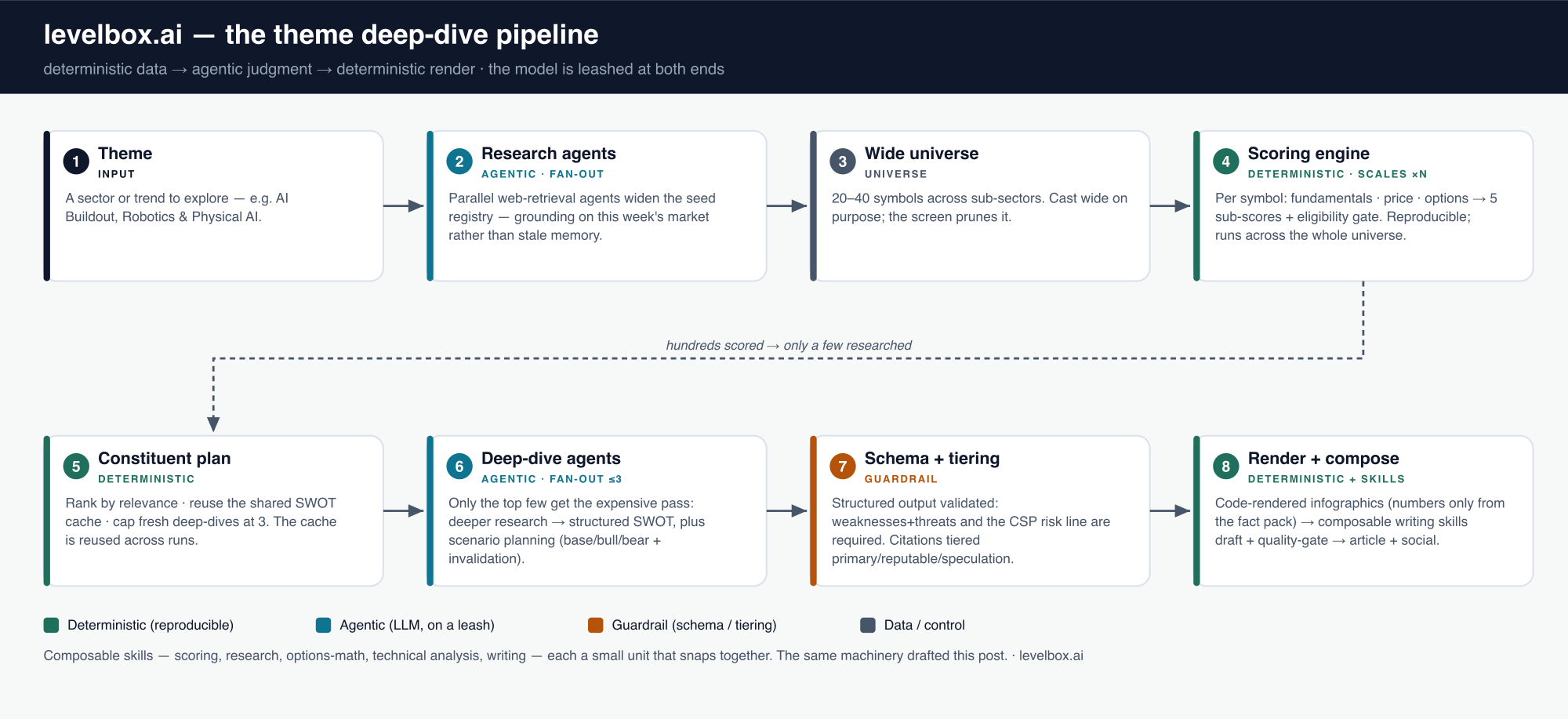
Theme in, agents out. Naming a theme doesn't fire one big prompt. It fans out. A set of research agents run in parallel, each doing its own web retrieval over a slice of the theme (a sub-sector, an ETF's holdings, the newer entrants), and their results merge into the working universe. Widening 40 names costs about the same wall-clock as five.
Scoring that scales, deterministically. Every symbol in that universe is scored by plain code rather than the model: fundamentals, price and options in; five sub-scores plus an eligibility gate out. It's per-symbol and embarrassingly parallel, with per-ticker isolation so one bad data pull can't sink the run. Hundreds of symbols can go in, the scoring stays reproducible, and the model's opinion never touches a number. That cheap deterministic pass over the whole universe is what lets it scale.
Then, and only then, the expensive part. The ranked universe gets capped. A shared cache serves any symbol deep-dived recently (keyed by ticker, invalidated by an earnings release), so only the top few uncached names, three by default, get a full agentic deep-dive: an LLM doing real research and emitting a structured SWOT. The costly step runs a handful of times rather than hundreds. NVDA scored in both the AI Buildout and Robotics themes, and the second run reused the first's work. That cache is what keeps running theme after theme sane.
It's composable skills underneath. None of this is a monolith. It's small, single-purpose skills that snap together: one scores, one researches, one does the options math, one does technical analysis, one writes, one gate-checks the words. The deep-dive skill just composes them. The same composition that produces a market write-up produces a technical one, so this very post came off the same rig. New capability is a new skill rather than a rewrite.
The honest part: this is early
Data quality is the ceiling on all of this, and it's the part we're always working to make better. Market feeds can be stale or occasionally wrong, and upgrading the underlying source is an ongoing effort rather than a solved problem. The screen's thresholds are first-pass and haven't been backtested against real outcomes. The scenario probabilities are considered judgment rather than a forecasting model: 50/25/25 is a number I'll defend, but it's still a guess. This is a headstart rather than an oracle. It turns the first few days of theme research into a few minutes, and the actual thinking is still on you.
If any of this is useful to how you invest, or if you reckon it's wrong, I'd genuinely like to know. Try the screener at levelbox.ai, read a theme deep-dive, and tell me where the screen or the narrative falls short. The deterministic screener, the part that shows premium, breakeven and max-loss on every candidate before you sell, sits at /app/screener.
Early, opinionated, and a lot better with your feedback.
Named tickers are illustrative examples rather than advice. This post was drafted with the tooling it describes; if you spot a mistake, tell us.
Common questions
- Does levelbox.ai pick stocks or give recommendations?
- No. levelbox.ai's live screener scores wheel candidates deterministically and shows the premium, breakeven and max-loss on each. Separately, I publish theme deep-dives that add scenario planning and SWOTs, with the bear case weighted equally to the bull. Named tickers are worked examples of how the screen scored them, rather than recommendations. The output is a structured starting point rather than a call to act.
- How does the deep-dive scale across a whole theme?
- The scoring is deterministic code rather than the model: fundamentals, price and options in, sub-scores plus an eligibility gate out, run per-symbol across the whole universe and reproducibly. Only the top few ranked names get the expensive agentic deep-dive (three by default), and a shared cache reuses any symbol analysed recently. Hundreds of symbols get scored cheaply; only a handful get the costly LLM pass.
- Is the analysis reliable enough to act on?
- It is an early headstart rather than an oracle. The numbers come from a reproducible data layer and every forward claim is tied to a tiered source, but market data can be stale and we're continually working to improve the underlying source, the screen's thresholds are first-pass and not yet backtested, and the scenario probabilities are considered judgment. The point is to compress the first days of theme research into minutes, then let a human do the real thinking.
Read next
- Technical Thoughts
Why a Poor Man's Covered Call Cannot Be a Runner
A poor man's covered call looks like cheap stock exposure with income on top. The arithmetic says the short call has to be sold close enough to cap you, because below about 0.20 delta it stops covering the long leg's decay.
- Technical Thoughts
More Delta Means More Yield, and More Risk. How We Found a Middle Ground
Selling deeper puts pays more premium and carries more risk. Choosing what delta to sell came down to targeting a chance of assignment rather than a delta label, plus explicit rules for which companies may carry it.
- Technical Thoughts
Your Option Book Is a Knapsack Problem (The Hard Kind)
Allocating capital across option positions makes portfolio optimization a knapsack problem, of the multi-dimensional, integer, class-constrained kind that has no efficient exact solution. Here is what our optimizer gives up to answer it anyway.